
Your needs, this model
Does it fit your priorities?
What aquarium size does the exact Aqueon AP100W-H manual recommend?
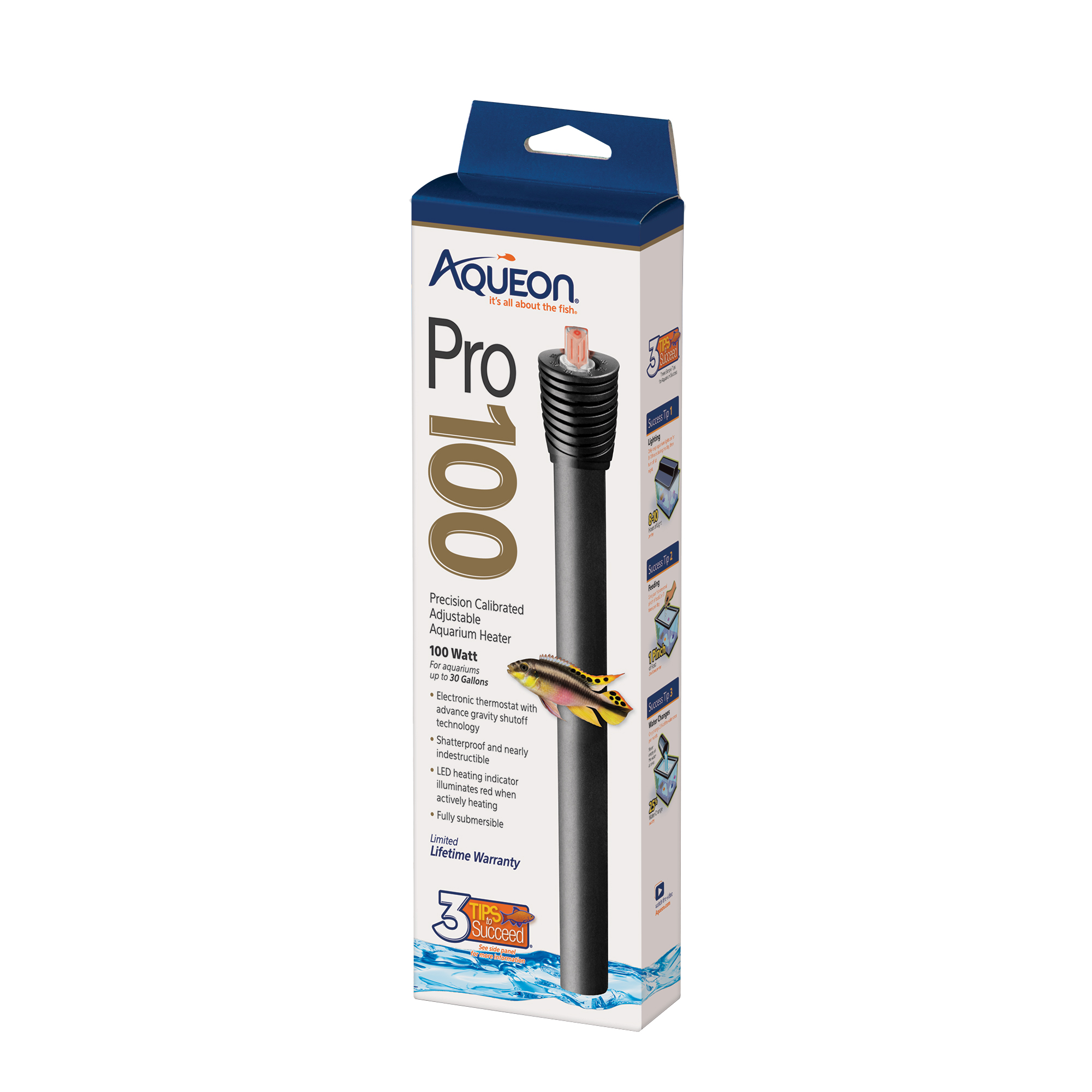
The current linked Aqueon instruction table gives the AP100W-H model a recommended range of 15–40 US gallons. The 2025 US catalog identifies this retail variant as item 100532084 / UPC 015905000581 and says up to 30 gallons. The catalog and manual upper claims differ, so do not collapse them into one number. The current finder checks a maximum only and cannot require the 15-gallon lower limit; this researched model is therefore withheld from matching and purchase recommendations.
Explore this need in the finder →What setting and temperature-check routine does the Aqueon Pro 100 W support?
Aqueon lists adjustable 68–88°F control and states thermostat accuracy within ±1°F; that is the maker’s specification, not an independent calibration or a digital display of aquarium water. The manual says to let the heater run for 24 hours at its original setting, check a reliable thermometer, adjust only slightly if needed, and wait another 24 hours before reassessing.
Explore this need in the finder →How must the Aqueon Pro 100 W be installed before power is applied?
The manual permits vertical or horizontal placement with suction cups. Vertically, keep water above the marked minimum; horizontally, keep the entire heater submerged. Maintain circulation and a drip loop, wait at least 30 minutes after submerging before plugging in, and never operate it out of water. A tilt shutoff is a protective response, not permission to run it in an incorrect position.
Explore this need in the finder →This is a document-based assessment of the Aqueon Pro Adjustable Aquarium Heater 100 W, item 100532084 / UPC 015905000581, corresponding by wattage to the AP100W-H entry in Aqueon’s current linked instructions. The manufacturer presents the Pro line as a fully submersible, adjustable electronic heater with a heat-resistant plastic body, a red heating indicator and a gravity shutoff. The exact family page names five size variants; the US catalog supplies the 100 W retail identifiers and dimensions, while the shared manual supplies the specific 100 W operating range. No claim here comes from ownership, laboratory testing or a measured aquarium.
The 100 W model has a meaningful published-range conflict
The instruction table recommends 15–40 US gallons for 100 W. The 2025 Aqueon catalog, which identifies this exact current item and UPC, says “up to 30 gallons.” Those claims overlap but are not the same ceiling. We preserve both rather than quietly promoting 40 gallons as an unqualified current package rating or treating the catalog as if it rewrote the manual. For comparison, the adjacent 50 W AP50W-H manual range is 5–20 gallons and the 150 W AP150W-H range is 30–55 gallons; those lower and upper endpoints are size-specific, not numbers to borrow for the 100 W model.
The dimensional sources also use distinct labels. The catalog lists a 1.5 by 1.75 by 10.375-inch item and a 3.5 by 1.5 by 10.375-inch retail package, while the manual calls the overall length 10.3 inches. A small numerical difference does not establish which dimension includes every protrusion or how much room the suction cups need. Check the physical space and exact product instructions; do not use carton size or a quoted overall length as a promised installed clearance.
Volume does not tell the whole heating story
Aqueon’s chart associates wattage with both tank size and the increase above a standard 68–72°F room. For a 20-gallon aquarium, it lists 100 W for a 10°F or 15°F rise; for 30 gallons, it lists 100 W for 5°F or 10°F and 150 W for 15°F. The chart is a planning table, not a cold-room capacity guarantee. The manual’s 15–40-gallon recommendation and the catalog’s “up to 30” rating therefore should not be converted into a one-number promise. Consider actual room lows, the intended livestock temperature and reliable thermometer readings. If those conditions are uncertain, a model’s wattage label cannot answer them by itself.
The current finder accepts the aquarium’s actual water volume and checks the documented upper field, but this 100 W manual also has a 15-gallon lower endpoint. The current matching schema cannot require both bounds for this product without applying an unsupported lower-bound assumption to the rest of the catalog. For that reason, the 100 W review is available for comparison but the heater is deliberately marked reference-only and is not a finder result or purchase recommendation.
Adjustment needs a thermometer and time
The Pro family’s adjustable control covers 68–88°F; Aqueon states thermostat accuracy within plus or minus 1°F. That statement is a manufacturer specification, not a measurement we repeated, and the sources reviewed do not establish a digital water-temperature display or independently verified step size. The manual calls for allowing 24 hours at the original setting, measuring the water with a reliable thermometer, making a small adjustment if necessary and waiting another 24 hours before repeating. The red knob light tells you the heater is actively heating, not what temperature the aquarium water has reached.
The manual permits vertical or horizontal installation with the included suction cups. Vertically, maintain water above the marked minimum; horizontally, keep the whole heater underwater. It must sit where water circulates, and it should be submerged for at least 30 minutes before power is applied. Keep a drip loop on the cord, unplug submerged electrical equipment before putting hands in the tank, and do not run the unit out of water. Aqueon’s gravity feature shuts it off if its top tips below its bottom; that protective response does not make incorrect positioning or dry operation acceptable.
What this model is—and is not—suited to
The plastic housing contains no glass components per the manual, an important distinction from a glass-tube heater for a keeper who wants to avoid glass. The manufacturer lists fresh- and saltwater use, adjustable control and inside-the-aquarium submersion. It does not document this model for inline installation with an external filter, and the source material does not support a phone app, remote alert, digital water reading or a guaranteed room-to-water temperature rise. The next wattage, 150 W, has a different manual size band and longer overall length; it should not be selected merely because a page’s 30-gallon catalog ceiling feels restrictive.
Assessment verdict
The Pro 100 W sits between smaller and larger Pro variants, but its sizing evidence is unusually important to read carefully: the manual says 15–40 gallons, whereas the current US catalog rates this exact SKU up to 30 gallons. Its manual gives a 10.3-inch overall length and the catalog records an item dimension of 10.375 inches. These source differences remain visible, and neither number is installation clearance. A careful buyer should confirm the 100 W / item / UPC combination on the carton and follow that exact package’s instructions. Since the published manual floor is not represented by our max-only volume matcher, this review is an assessment of documentation—not an endorsement for a particular tank size.
Primary references: Aqueon Pro family selector, linked AP50W-H–AP300W-H instruction manual, and Aqueon 2025 US catalog. No current retailer stock or price is inferred.
Key specifications
Key details at a glance
| Rated heater power | 100 W |
|---|---|
| Manufacturer aquarium rating | 30 US gal |
| Lowest thermostat setting | 68°F |
| Highest thermostat setting | 88°F |
| Temperature control | Adjustable thermostat |
| Supported water types | freshwater / saltwater |
| Installation route | Fully submerged, in-tank |
| Electrical supply | 120 V |
| Line frequency | 60 Hz |
Use the exact model’s instructions for operating limits, supplied equipment and version differences.
Paper, software and setup details
Manual-recommended aquarium range
[15, 40] US gal
Sources for this review
Sources for this assessment

Check the complete aquarium setup
Use the finder to compare documented tank size, water type, installation and temperature-control fit. A match does not guarantee the keeper's species-specific target or measured performance.