
Your needs, this model
Does it fit your priorities?
Which tank-volume range does Finnex publish for the HMA-200s?
Finnex lists 60–80 US gallons for this 200 W HMA row. At 60 gallons it shares a published endpoint with the 150 W model; at 80 gallons it meets the 300 W model’s lower endpoint. Those table overlaps are not a promise of equal performance, and the present finder cannot enforce the 60-gallon minimum.
Explore this need in the finder →What setting range is documented for the HMA-200s?
The HMA table gives 68–92°F. Finnex’s family prose claims ±2°F around the setting and labels the controller analog, but also uses “electronic” language. No independent accuracy or temperature-recovery test was reviewed; use a separate thermometer and treat the claim as a reference only.
Explore this need in the finder →Does Finnex state that the HMA-200s is for saltwater?
The manufacturer’s HMA description expressly includes saltwater as well as freshwater. It does not, in the inspected source set, provide a model-specific setup manual or complete input-voltage/frequency specification. Verify those details on an exact package and do not infer a plumbing or submerged arrangement from the family photograph.
Explore this need in the finder →The exact 200 W row
Finnex’s HMA family table identifies the HMA-200s as a 200 W titanium aquarium-heater configuration. Its row lists 1.8 A at 115 V, the family’s 68–92°F control range and a 60–80 US-gallon aquarium band. The size band is the important model-specific distinction: the 150 W HMA-150s ends at 60 gallons and the 300 W HMA-300s starts at 80. Those endpoint overlaps make the table useful for identifying adjacent entries, but they do not establish equal heating behavior for every tank sharing a boundary.
The table’s footnote limits its capacity claim to a standard enclosed aquarium and describes maximum heating capacity as ±8°F above ambient. It therefore is not a guarantee for every room or tank shape, nor a substitute for evaluating the temperature gap from ambient. The manufacturer’s published range remains the only capacity interpretation available here; no calculation or independent performance test is being added.
Why 60–80 gallons is not an “up to 80” label
The lower endpoint matters just as much as the maximum. A 40-gallon setup is below Finnex’s stated 60-gallon band, despite being under the table’s 80-gallon maximum. The current matcher recognizes only maximum capacity, not this minimum, so an eligible listing could be returned for tanks the manufacturer did not list in that band. The HMA-200s is therefore held out of finder results and ordinary questionnaire-based purchase recommendations. Its separate model-reference lookup is for identifying this documented row and checking its limits; it is not a compatibility approval. That is a limit of the available evidence and matcher representation, not a claim that the heater is defective.
At 60 gallons, the HMA-150s and HMA-200s share an endpoint; at 80 gallons, the HMA-200s and HMA-300s meet. The published wattage and capacity table can narrow the next model to inspect, but it does not explain ambient assumptions in detail, circulation, exact tank construction or animal-specific needs. Do not select the next larger row by wattage alone.
Controller claims are not test results
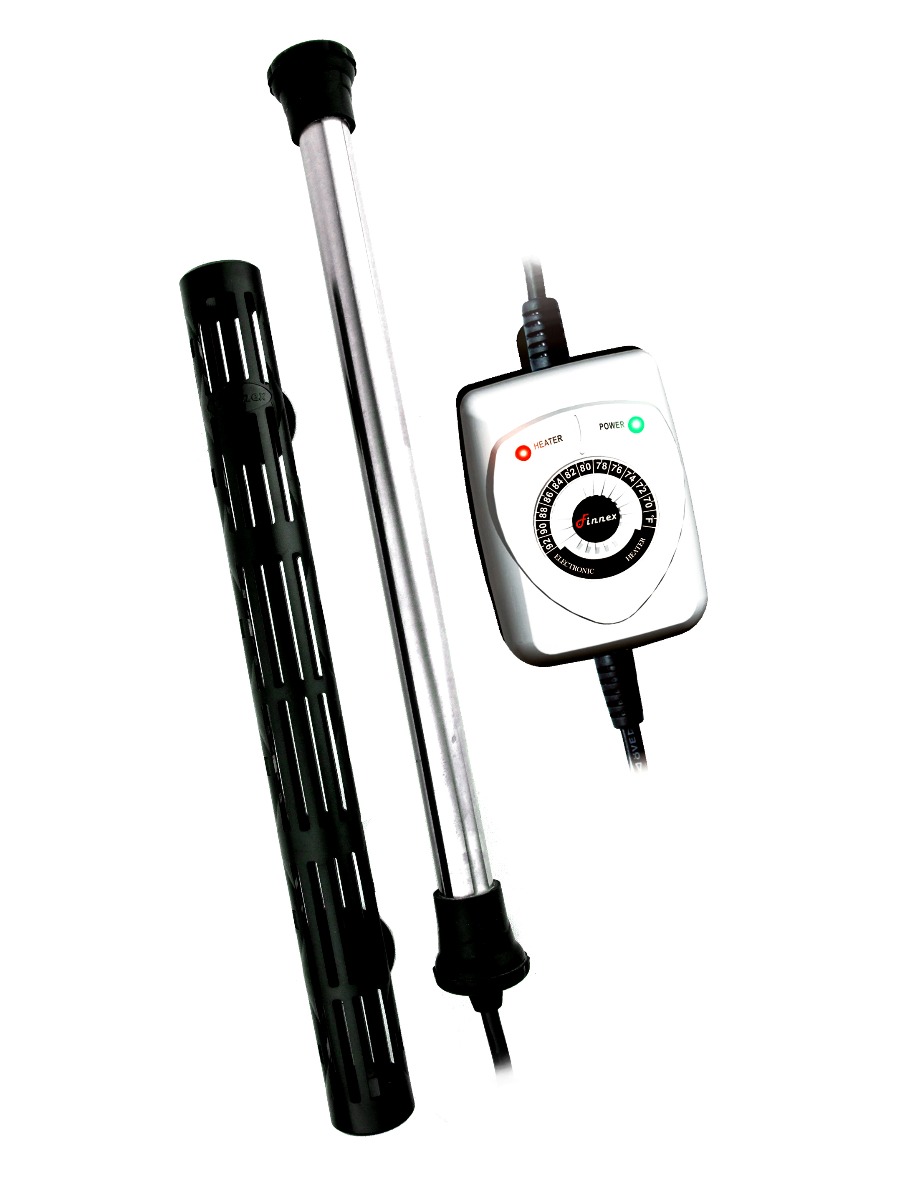
The page says HMA heaters have a precision analog controller, an LED heating indicator and an encasing guard with suction cups. Its descriptive copy also says “electronic control” and makes a ±2°F control-tolerance claim. The combination of analog and electronic language may reflect wording choices rather than separate controls; the evidence does not justify inventing two operating modes. A dial can set a temperature, but it is not a digital water-temperature display. The listed 68–92°F range and ±2°F figure are manufacturer statements, not independently measured results. Keep a separate aquarium thermometer for actual water.
The titanium-tube and corrosion-resistance statements, and the page’s freshwater/saltwater suitability claim, are likewise manufacturer descriptions. They are useful differentiators from a glass-bodied heater but do not verify the HMA-200s’s exact installation method. The reviewed family source does not state immersion depth, mounting orientation, clearance or an inline-plumbing route. The generic image should not be used to infer those answers.
Missing model-level details and seller checks
There is no SKU or UPC in the exact HMA table row, and no body-length or package-dimension data. Finnex states amperage at 115 V, but not the full supply voltage range or frequency, so the exact unit label matters before connecting it. The public instructions index lists an HMH manual, not an HMA manual. I have not reused the HMH document because the HMH designation is a different family. Finnex’s general warranty page states 180 days for the original purchaser under normal use and excludes dry-burn damage, but no current HMA-200s package or seller offer was verified against that term.
The manufacturer HMA hero is a shared image with a tube, controller and guard but no 200 W identifier; the second image is component art. Neither proves exact-model identity, so this page leaves the exact-product-photo field open. Before buying any offer described as HMA-200s, confirm the full model code, actual voltage/frequency and wattage on the package, exact setup manual, return window and warranty eligibility.
Assessment
The HMA-200s is a separate, documented row for 60–80 US gallons, not a generic capacity inferred from another Finnex titanium product. Finnex’s control and material claims may make it worth comparing against a known model, but the missing installation/electrical details and unverified retail identity prevent a complete compatibility judgment. The published 60-gallon minimum cannot be enforced by this site’s current numeric rule, so the article stays reference-only. It is useful for understanding the manufacturer’s stated band and the exact evidence still needed, not for approving use in a specific aquarium.
Key specifications
Key details at a glance
| Rated heater power | 200 W |
|---|---|
| Lowest thermostat setting | 68°F |
| Highest thermostat setting | 92°F |
| Temperature control | Adjustable thermostat |
| Supported water types | freshwater / saltwater |
Use the exact model’s instructions for operating limits, supplied equipment and version differences.
Sources for this review
Sources for this assessment
Check the complete aquarium setup
Use the finder to compare documented tank size, water type, installation and temperature-control fit. A match does not guarantee the keeper's species-specific target or measured performance.