
Your needs, this model
Does it fit your priorities?
What aquarium volume does Finnex list for the HMH-200S?
The exact HMH manual lists a 60–80 US-gallon range for HMH-200S at 200 W. That is a manufacturer band, not an independently tested guarantee; the max-only finder cannot enforce its 60-gallon minimum. The product therefore remains outside finder matches rather than being treated as suitable for every smaller volume.
Explore this need in the finder →How does the HMH-200S control temperature and sense water conditions?
The HMH manual documents a 50–94°F adjustable digital setting with 0.1°F increments and stated display accuracy of ±0.5°F. That is the maker’s display specification, not a measured stability result. The HMH-200S uses the sensor built into the heater tube, not the separate water probe used by HMS. Finnex’s HMH manual says to keep the sensor area at the cord/heating-element junction higher than the rest of the heater; check the exact manual diagrams before mounting. The family page also requires water above 150 ppm TDS.
Explore this need in the finder →Can the HMH-200S be installed inside an aquarium?
The HMH manual requires full immersion, a suction-cup hold against glass, free water movement around the tube, and the built-in sensor area higher than the rest. It suggests a location near a filter or wavemaker and also allows a filter sump. Use a GFCI-protected supply and drip loop, wait 15 minutes before plugging in, and unplug/cool for 15 minutes before removal. This is not evidence for inline plumbing. The manufacturer describes freshwater and marine use but requires water above 150 ppm TDS; verify water chemistry, exact supply rating and exact package instructions.
Explore this need in the finder →For the 60–80 gallon band
The HMH-200S is the 200 W entry in the Finnex internal-sensor digital titanium range. The manual assigns it a 60–80 US-gallon aquarium band and an 11.61-inch tube. That length is notably greater than the 150 W HMH-150S’s 8.86 inches; it should be checked against the actual submerged space, water line and intended suction-cup position. The manual’s lower boundary begins at 60 gallons while the next 300 W row begins at 80, so both exact endpoints matter when comparing the paper-defined sizes.
Finnex lists 1.80 A at 115 V for this model, a 55-inch power cord, a 35.4-inch controller-to-heater cord and a 47-inch sensor cord. These are source-table values for routing and identity checks. They do not establish the heater’s complete electrical nameplate: voltage and frequency still need to be verified on the exact package or product label. The current official Shop collection and the HMH search page reviewed for this cycle did not provide an exact HMH-200S variant, SKU or UPC. That limited absence is not proof of discontinuation, but it is a reason not to invent a present retail offer.
Know which part senses the water
HMH measures through a sensor built into the tube. Finnex says the cord/heating-element junction—the sensor area—must be elevated above the heater’s remaining length. The separate HMS family uses a remote sensor whose placement instructions are different. Mount HMH-200S against glass with its suction cups, leave the tube in freely moving water and avoid pressure on the end caps or cord. A position near a filter or wavemaker is the maker’s example; a filter sump is also allowed. The manual does not describe an inline external-filter hose installation.
The controller’s range is 50–94°F with 0.1°F adjustments; Finnex gives ±0.5°F as display accuracy. This does not mean every 60–80 gallon aquarium will hold that setting to within the same tolerance. A separate thermometer is needed to compare the water itself with the display. The dry-sensor precaution also has a narrower limit: according to the manual, the low-water alarm/cutoff operates from 58–92°F, but is disabled outside that range, where heating may continue with the sensor exposed. Do not conflate an available setpoint with an active safety function.
Preparation and maintenance are part of the fit
Finnex instructs users to let the unit acclimate to the aquarium’s water for 15 minutes before power, form a drip loop and plug into a GFCI-protected outlet. Unplug aquarium devices before any maintenance and wait at least 15 minutes after disconnecting the heater before removing it. The manual calls for a 30-day sensor check and cleaning schedule. A water heater is not a set-and-forget substitute for observing actual temperature or water level; if the controller reports an exposed sensor, the manual’s reset procedure begins only after submersion is restored.
Why it remains a reference rather than a finder result
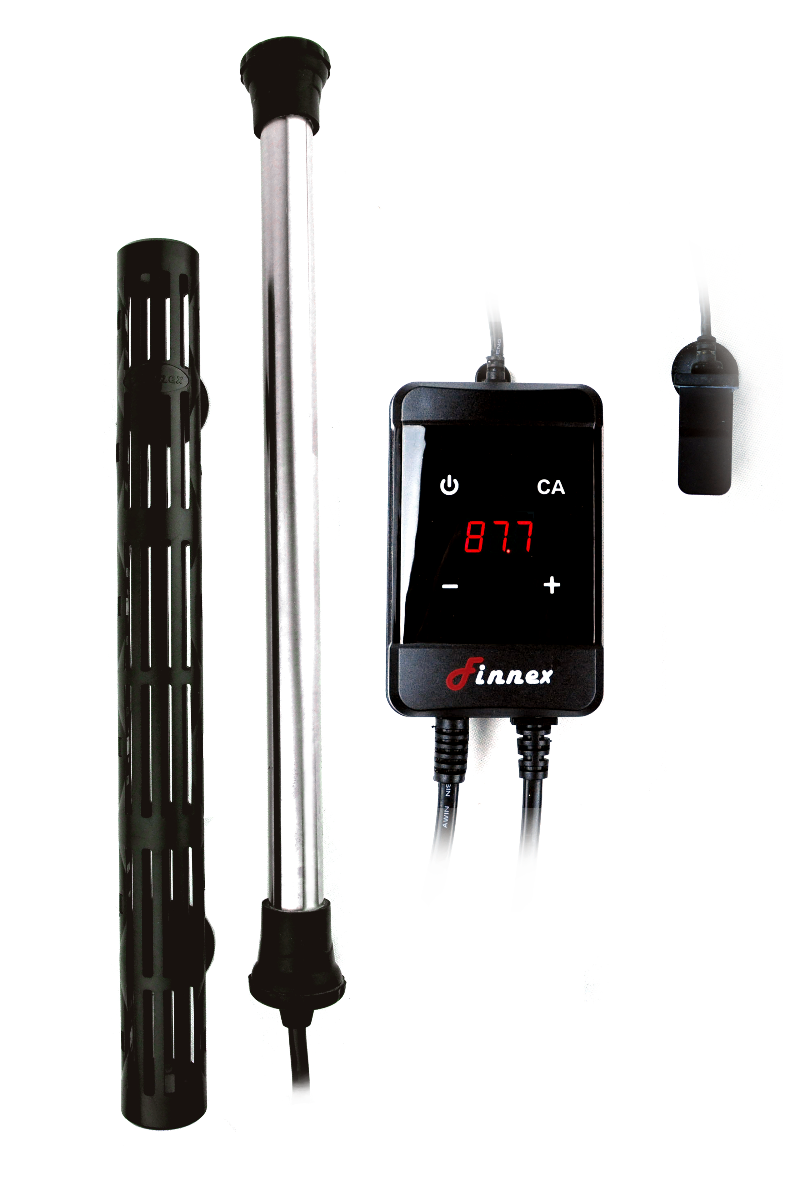
The 60-gallon minimum is not enforced by the present maximum-only volume question. If this model were marked as a normal candidate based only on its 80-gallon ceiling, it could be offered to an undersized tank. It is therefore reference-only, with its source-backed band preserved for people checking a label. The manufacturer also says HMH use is for freshwater and marine water above 150 ppm TDS, a conductivity constraint not represented by the current question choices. The table leaves complete voltage/frequency input and a current exact retail configuration unresolved. No exact HMH-200S photo has been verified, and generic family art is not substituted.
The model’s practical distinction is not simply “200 W”: it is the combination of an 11.61-inch built-in-sensor tube, 60–80 gallon table band and specific cable lengths. Compare those values with the exact mounting space and independent aquarium needs. This review reports manufacturer specifications and limitations; it does not claim hands-on use, measured heating performance or suitability for a species-specific temperature target.
Key specifications
Key details at a glance
| Rated heater power | 200 W |
|---|---|
| Lowest thermostat setting | 50°F |
| Highest thermostat setting | 94°F |
| Temperature control | Adjustable thermostat |
| Supported water types | freshwater / saltwater |
| Installation route | Fully submerged, in-tank |
| Heater length | 11.61 in |
Use the exact model’s instructions for operating limits, supplied equipment and version differences.
Paper, software and setup details
Manual-recommended aquarium range
60–80 US gal
Sources for this review
Sources for this assessment
Check the complete aquarium setup
Use the finder to compare documented tank size, water type, installation and temperature-control fit. A match does not guarantee the keeper's species-specific target or measured performance.