
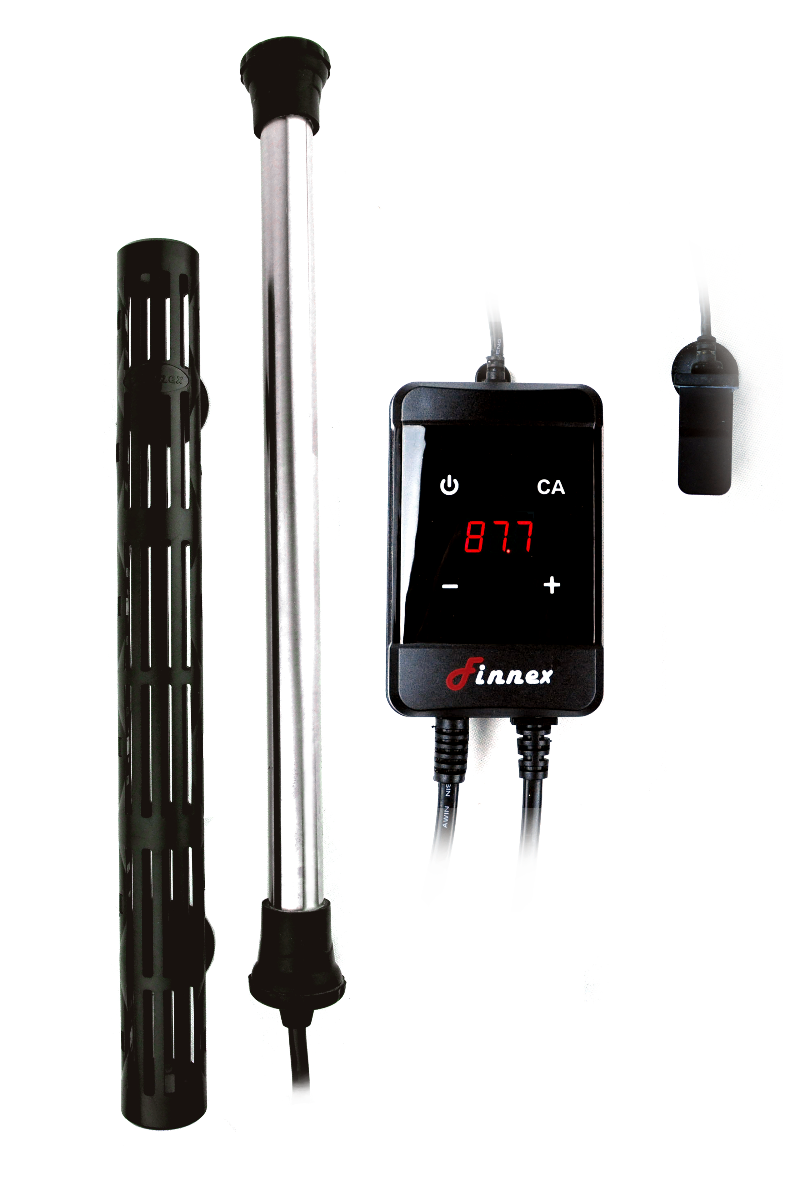
Your needs, this model
Does it fit your priorities?
What aquarium volume does Finnex list for the HMH-300S?
The exact HMH manual lists a 80–100 US-gallon range for HMH-300S at 300 W. That is a manufacturer band, not an independently tested guarantee; the max-only finder cannot enforce its 80-gallon minimum. The product therefore remains outside finder matches rather than being treated as suitable for every smaller volume.
Explore this need in the finder →How does the HMH-300S control temperature and sense water conditions?
The HMH manual documents a 50–94°F adjustable digital setting with 0.1°F increments and stated display accuracy of ±0.5°F. That is the maker’s display specification, not a measured stability result. The HMH-300S uses the sensor built into the heater tube, not the separate water probe used by HMS. Finnex’s HMH manual says to keep the sensor area at the cord/heating-element junction higher than the rest of the heater; check the exact manual diagrams before mounting. The family page also requires water above 150 ppm TDS.
Explore this need in the finder →Can the HMH-300S be installed inside an aquarium?
The HMH manual requires full immersion, a suction-cup hold against glass, free water movement around the tube, and the built-in sensor area higher than the rest. It suggests a location near a filter or wavemaker and also allows a filter sump. Use a GFCI-protected supply and drip loop, wait 15 minutes before plugging in, and unplug/cool for 15 minutes before removal. This is not evidence for inline plumbing. The manufacturer describes freshwater and marine use but requires water above 150 ppm TDS; verify water chemistry, exact supply rating and exact package instructions.
Explore this need in the finder →A longer tube for Finnex’s 80–100 gallon row
The HMH-300S is Finnex’s 300 W internal-sensor titanium configuration, listed for 80–100 US gallons. Its 12.80-inch tube is the second longest HMH size in the manual, after the HMH-500S at 15.55 inches. This model begins where the 200 W row ends: both share the 80-gallon boundary, but the HMH-300S carries the 80–100 gallon range and its own power/cable values. A tank-volume label alone does not establish the heater’s physical fit, so measure submerged room and check the exact suction-cup orientation before choosing the model.
The source table specifies 2.70 A at 115 V, a 55-inch power cord, a 39-inch controller-to-heater cord and a 47-inch sensor cord. The shorter control lead compared with the 500 W row may affect where the external display can sit, but it should not be extended or rerouted against an unverified electrical instruction. The manual table does not state a complete voltage/frequency nameplate, and the inspected current official Shop pages did not resolve a model-specific HMH-300S retail SKU, UPC or variant. Check the exact package rather than treating the family table as proof of an available offer.
Internal sensing and a limited dry-protection window
The HMH-300S reads through its built-in tube sensor. Finnex identifies the junction at the heater cord as the sensor location and says it should remain higher than the rest of the element. HMS units instead use an external probe; their separate setup instructions should not be applied to this family. For HMH, the manual recommends a spot near moving water, secured to glass with suction cups, with no pressure on the tube ends or cord. It also permits placement in a filter sump, provided the heater remains fully submerged.
Its digital control spans 50–94°F in tenth-degree increments. Finnex states the controller display is accurate to ±0.5°F, but that does not certify the aquarium’s water as stable at a particular temperature. Use an independent thermometer. There is a consequential interaction between the broad setting range and low-water safety: the manual says the low-water warning and cutoff function from 58–92°F only. Outside that range, the system is disabled and the heater can continue heating when its sensor is out of water. A high-temperature alert above 95°F is a warning to unplug and investigate, not proof that the unit has independently maintained a safe tank.
Plan installation before switching it on
Finnex’s instructions call for completely immersing the HMH-300S, allowing 15 minutes for the heater to approach water temperature before power, using a drip loop, and connecting through a GFCI-protected receptacle. Unplug aquarium equipment before maintenance and allow the heater to cool for at least 15 minutes before removal. Check and clean the sensor every 30 days as directed. These are not discretionary accessories: the sensor’s location, circulation and power routine are part of the manufacturer’s stated operation.
Read the 80–100 gallon band as a boundary
The 100-gallon top is a maximum, not an all-purpose heating guarantee. Room temperature, tank cover and water circulation can change the heat load; Finnex’s table does not convert the range into a promise for every environment. The 80-gallon lower endpoint also matters, but the current finder only applies maximum-capacity rules. HMH-300S stays reference-only rather than being shown as a suitable 1–100 gallon option. Finnex says the family is for freshwater and marine aquariums where TDS is above 150 ppm. The control range, exact electrical package, current sale configuration and photo identity should be verified separately.
For exact identification, compare the manual label HMH-300S, its 300 W rating, the 80–100 gallon band, 12.80-inch tube and 39-inch controller lead. This is a source-based model assessment, not an independent test or proof the heater is right for a particular aquarium’s livestock or target temperature.
Key specifications
Key details at a glance
| Rated heater power | 300 W |
|---|---|
| Lowest thermostat setting | 50°F |
| Highest thermostat setting | 94°F |
| Temperature control | Adjustable thermostat |
| Supported water types | freshwater / saltwater |
| Installation route | Fully submerged, in-tank |
| Heater length | 12.8 in |
Use the exact model’s instructions for operating limits, supplied equipment and version differences.
Paper, software and setup details
Manual-recommended aquarium range
80–100 US gal
Sources for this review
Sources for this assessment
Check the complete aquarium setup
Use the finder to compare documented tank size, water type, installation and temperature-control fit. A match does not guarantee the keeper's species-specific target or measured performance.