
Your needs, this model
Does it fit your priorities?
What aquarium volume does Finnex list for the HMH-500S?
The exact HMH manual lists a 100–120 US-gallon range for HMH-500S at 500 W. That is a manufacturer band, not an independently tested guarantee; the max-only finder cannot enforce its 100-gallon minimum. The product therefore remains outside finder matches rather than being treated as suitable for every smaller volume.
Explore this need in the finder →How does the HMH-500S control temperature and sense water conditions?
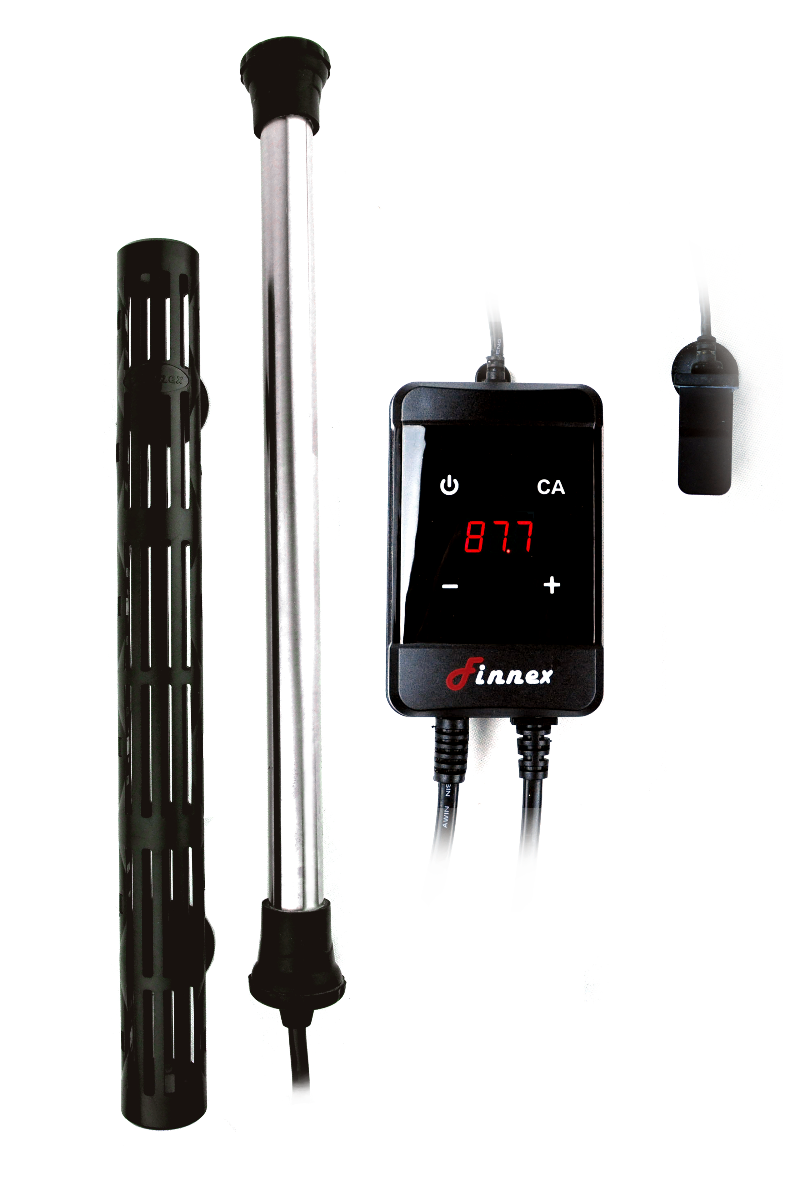
The HMH manual documents a 50–94°F adjustable digital setting with 0.1°F increments and stated display accuracy of ±0.5°F. That is the maker’s display specification, not a measured stability result. The HMH-500S uses the sensor built into the heater tube, not the separate water probe used by HMS. Finnex’s HMH manual says to keep the sensor area at the cord/heating-element junction higher than the rest of the heater; check the exact manual diagrams before mounting. The family page also requires water above 150 ppm TDS.
Explore this need in the finder →Can the HMH-500S be installed inside an aquarium?
The HMH manual requires full immersion, a suction-cup hold against glass, free water movement around the tube, and the built-in sensor area higher than the rest. It suggests a location near a filter or wavemaker and also allows a filter sump. Use a GFCI-protected supply and drip loop, wait 15 minutes before plugging in, and unplug/cool for 15 minutes before removal. This is not evidence for inline plumbing. The manufacturer describes freshwater and marine use but requires water above 150 ppm TDS; verify water chemistry, exact supply rating and exact package instructions.
Explore this need in the finder →The largest HMH size in this manual
Finnex lists HMH-500S at 500 W for 100–120 US gallons, the largest capacity band in the HMH table reviewed here. Its titanium tube is 15.55 inches long; that is 2.75 inches longer than the 300 W HMH-300S and more than twice the length of the 50 W tube. Confirm there is enough submerged wall space for the heater to sit securely, with open water movement around the tube and without putting force on the cord or end caps. The manufacturer’s 100–120 gallon range describes a sizing interval, not a guarantee that 500 W is appropriate for every 100-gallon layout or climate.
The 500 W row lists 4.50 A at 115 V, a 55-inch power cord, 47-inch controller-to-heater cord and 47-inch sensor cord. Those longer equipment runs may matter in a cabinet or sump arrangement, but they are not a substitute for checking actual routing and outlet position. The HMH manual does not provide the complete voltage/frequency nameplate for this individual model. No exact retail SKU, UPC or current Shop variant was resolved in the bounded official store collection and search. It would be misleading to infer current stock or electrical compatibility from a family chart alone.
The controller uses an internal sensor
Unlike the HMS design, HMH locates the temperature sensor within the heater tube. Finnex identifies the point at which the element meets the cord as the low-water sensor area and instructs that it stay higher than the rest of the heater. This requirement can constrain how a long tube fits beneath a lid or beside other equipment. Use the suction cups on aquarium glass, keep the heater fully submerged and choose a position with circulation—Finnex suggests near a filter or wavemaker and also permits a filter sump. A sump does not imply that the heater can be placed inline in an external filter hose.
The control can be adjusted from 50–94°F in 0.1°F steps. Finnex states ±0.5°F display accuracy; that is not a measured result for a real aquarium. The 500 W setting should be cross-checked against a separate thermometer. The manual’s low-water warning/cutoff works only from 58–92°F. Outside this narrower interval, it is disabled and the heater may continue heating if the sensor is dry. The instructions also describe an above-95°F audio alert and tell the user to unplug and investigate. These boundaries matter when reading the attractive long adjustment range: not every available setpoint retains the same described low-water protection.
Electrical handling and ongoing checks
Before operation, Finnex calls for a 15-minute acclimation after putting the heater in water, a drip loop and a GFCI-protected receptacle. Disconnect aquarium appliances before cleaning, then allow 15 minutes for the heater to cool before moving it. The manual asks for a sensor clean-and-function check every 30 days; mineral buildup should be handled with power disconnected. If low-water protection has activated, it must be submerged again and reset as described. These instructions complement, rather than replace, an independent thermometer and observation of water level.
Why it remains an assessment reference
One hundred gallons is a meaningful lower limit; the existing volume filter cannot enforce it and would otherwise treat the 120-gallon maximum as sufficient for any smaller tank. HMH-500S therefore stays out of buying matches. Finnex’s family overview says freshwater and marine use but requires TDS above 150 ppm, which is an additional condition not asked in the public finder. The reviewed manual supplies useful wattage, capacity, control and cord data, but not the full electrical label or a current individual retail package. No exact wattage-specific product photo was verified. The HMH-500S assessment is therefore a way to check an exact label and its setup constraints, not a claim that a 500 W heater is right for a given tank or that it has been tested here.
Key specifications
Key details at a glance
| Rated heater power | 500 W |
|---|---|
| Lowest thermostat setting | 50°F |
| Highest thermostat setting | 94°F |
| Temperature control | Adjustable thermostat |
| Supported water types | freshwater / saltwater |
| Installation route | Fully submerged, in-tank |
| Heater length | 15.55 in |
Use the exact model’s instructions for operating limits, supplied equipment and version differences.
Paper, software and setup details
Manual-recommended aquarium range
100–120 US gal
Sources for this review
Sources for this assessment
Check the complete aquarium setup
Use the finder to compare documented tank size, water type, installation and temperature-control fit. A match does not guarantee the keeper's species-specific target or measured performance.