
Your needs, this model
Does it fit your priorities?
What aquarium volume does Finnex list for the HMS-200S?
The exact HMS manual lists a 60–80 US-gallon range for HMS-200S at 200 W. That is a manufacturer band, not an independently tested guarantee; the max-only finder cannot enforce its 60-gallon minimum. The product therefore remains outside finder matches rather than being treated as suitable for every smaller volume.
Explore this need in the finder →How does the HMS-200S control temperature and sense water conditions?
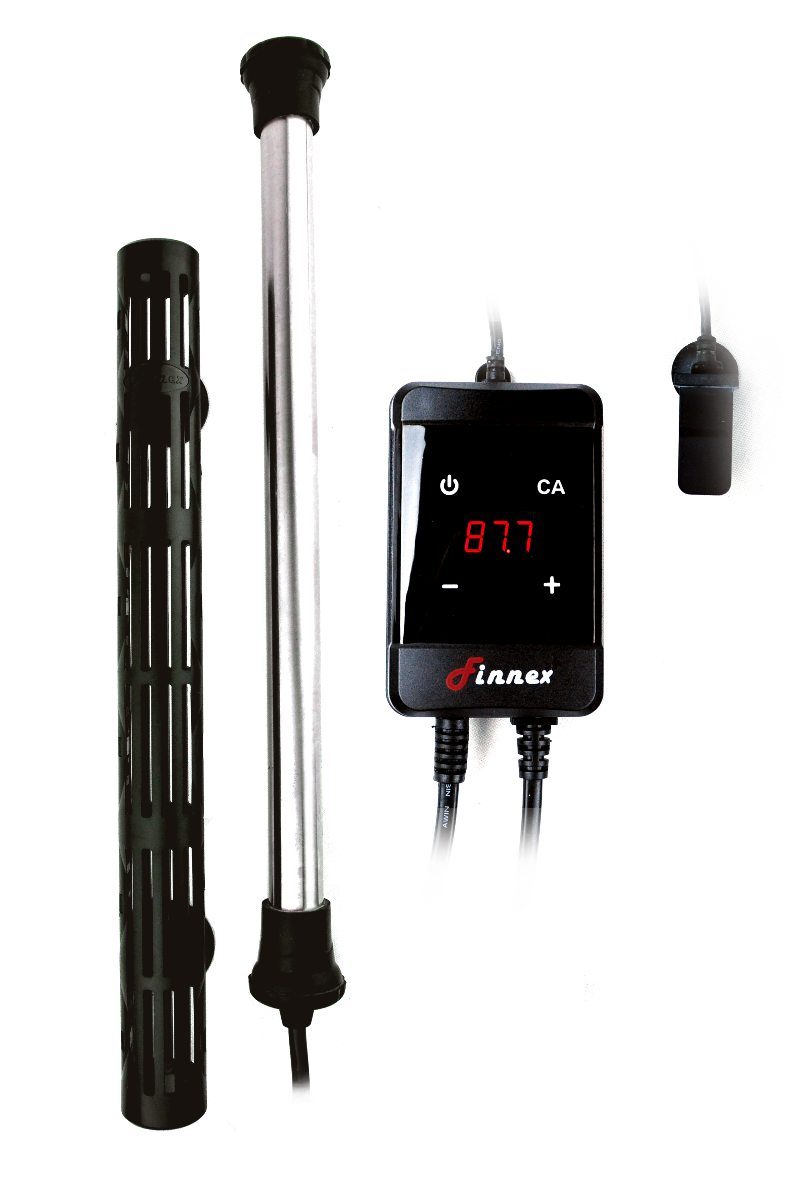
The HMS manual documents a 50–94°F adjustable digital setting with 0.1°F increments and stated display accuracy of ±0.5°F. That is the maker’s display specification, not a measured stability result. The HMS-200S uses an external water sensor separate from the titanium tube. Finnex’s HMS manual says to position the probe slightly above the tube, just below its clip without slack, and keep it submerged near the heater; this is different from HMH’s built-in sensor arrangement. The family page also requires water above 150 ppm TDS.
Explore this need in the finder →Can the HMS-200S be installed inside an aquarium?
The HMS manual requires the heater itself fully submerged in the aquarium or sump, secured with suction cups in moving water, and its remote sensor underwater near and slightly above the tube. Allow 15 minutes for temperature acclimation before power; use a GFCI outlet and drip loop. Within the manual’s 58–92°F low-water protection range, exposure stops heating and sounds an alert; outside that range the low-water system is disabled and the manual warns the heater may continue heating. The manufacturer describes freshwater and marine use but requires water above 150 ppm TDS; verify water chemistry, exact supply rating and exact package instructions.
Explore this need in the finder →Fit the tube and probe in a 60–80 gallon layout
The HMS-200S is the 200 W remote-sensor titanium entry for Finnex’s stated 60–80 US-gallon band. Its tube is 11.22 inches long, 1.20 inches longer than the HMS-150S and shorter than the HMS-300S at 12.40 inches. The model band shares the 80-gallon edge with the 300 W row, but the source tables assign distinct wattage and physical dimensions to each. Measure usable submerged space and plan the probe route rather than choosing by volume alone.
Finnex lists 1.80 A at 115 V, 55 inches for the power cord, 35.4 inches from controller to heater, and 47 inches for the sensor cord. Those lengths matter in a stand or sump, where the controller may need to remain outside water while the heater and probe sit submerged. They are not operating-clearance values or a reason to strain a lead. The manual does not state the full voltage/frequency supply nameplate for this exact configuration. No individual HMS-200S retail SKU, UPC or current Shop variant was resolved in the inspected official collection/search; verify the label and included sensor before use.
Use the separate probe as instructed
The HMS-200S senses aquarium water with a remote probe. Finnex’s manual says the probe belongs slightly above the heating tube, underwater, beneath the sensor cord clip and without slack. It should sit just above the heater so the controller can read tank water and detect exposure. This differs from HMH’s internal sensor. In an aquarium with a lid, return plumbing or many cables, the probe can be the limiting part of the installation even when the 11.22-inch tube fits.
Finnex gives a 50–94°F adjustment range in 0.1°F steps and states ±0.5°F display accuracy. That is not a measured performance result in an aquarium, and the display should be compared with a separate thermometer. The manual further limits the out-of-water warning/cutoff to 58–92°F. At settings outside that range the low-water system is disabled, so an exposed remote sensor can leave the heater running. An above-95°F audio alert is also described; the instructions say to unplug and check the setup if it sounds. These limits are easy to miss if a shopper looks only at the broader controller range.
Safe operation is fully submerged and deliberate
Secure the heater to aquarium glass with its suction cups near moving water, such as a filter or wavemaker, while keeping the probe underwater in the required position. Finnex permits a filter sump; it does not describe inline use in an external filter hose. Allow 15 minutes for the unit to acclimate in water before connecting power. Use a drip loop and GFCI-protected supply. Unplug aquarium appliances before maintenance and wait 15 minutes for the heater to cool before removal. Check and clean the remote sensor every 30 days. After an exposure event in the active low-water range, Finnex instructs the user to submerge and reset the sensor/controller before normal use resumes.
The capacity floor remains important
The published 60-gallon lower limit is not enforced by the current maximum-only volume question. The HMS-200S is therefore a reference-only configuration; it is not presented as a finder candidate for every tank up to 80 gallons. Finnex’s HMS overview describes freshwater and marine use but requires more than 150 ppm TDS. Verify that condition independently, as water type alone cannot establish it. The missing complete supply rating, exact current retail option and model-specific image are additional unresolved checks.
The useful identifiers are the HMS prefix, 200 W, 60–80 gallons, an 11.22-inch element and its listed sensor/controller leads. These facts can help distinguish it from the similar HMH-200S with its internal sensor and slightly longer 11.61-inch tube. This is a source-limited comparison, not a test, guarantee or livestock-specific temperature recommendation.
Key specifications
Key details at a glance
| Rated heater power | 200 W |
|---|---|
| Lowest thermostat setting | 50°F |
| Highest thermostat setting | 94°F |
| Temperature control | Adjustable thermostat |
| Supported water types | freshwater / saltwater |
| Installation route | Fully submerged, in-tank |
| Heater length | 11.22 in |
Use the exact model’s instructions for operating limits, supplied equipment and version differences.
Paper, software and setup details
Manual-recommended aquarium range
60–80 US gal
Sources for this review
Sources for this assessment
Check the complete aquarium setup
Use the finder to compare documented tank size, water type, installation and temperature-control fit. A match does not guarantee the keeper's species-specific target or measured performance.