
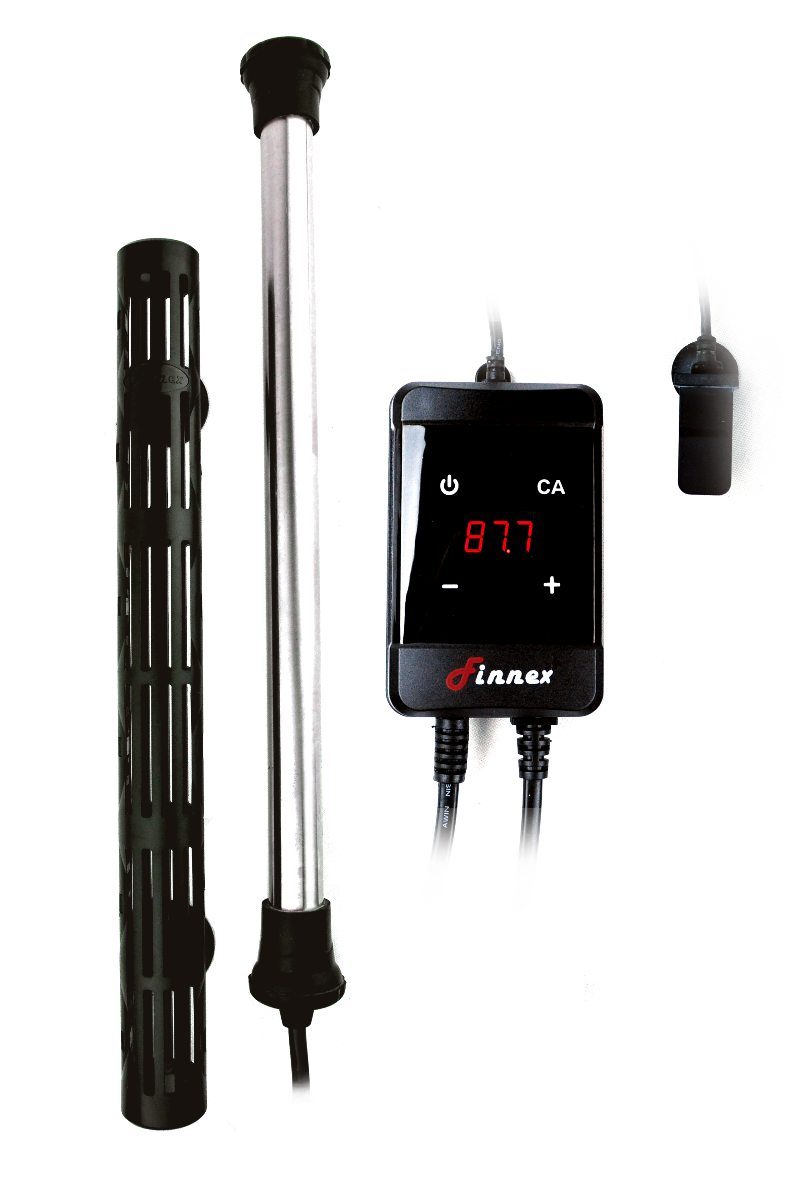
Your needs, this model
Does it fit your priorities?
What aquarium volume does Finnex list for the HMS-50S?
The exact HMS manual lists a 10–20 US-gallon range for HMS-50S at 50 W. That is a manufacturer band, not an independently tested guarantee; the max-only finder cannot enforce its 10-gallon minimum. The product therefore remains outside finder matches rather than being treated as suitable for every smaller volume.
Explore this need in the finder →How does the HMS-50S control temperature and sense water conditions?
The HMS manual documents a 50–94°F adjustable digital setting with 0.1°F increments and stated display accuracy of ±0.5°F. That is the maker’s display specification, not a measured stability result. The HMS-50S uses an external water sensor separate from the titanium tube. Finnex’s HMS manual says to position the probe slightly above the tube, just below its clip without slack, and keep it submerged near the heater; this is different from HMH’s built-in sensor arrangement. The family page also requires water above 150 ppm TDS.
Explore this need in the finder →Can the HMS-50S be installed inside an aquarium?
The HMS manual requires the heater itself fully submerged in the aquarium or sump, secured with suction cups in moving water, and its remote sensor underwater near and slightly above the tube. Allow 15 minutes for temperature acclimation before power; use a GFCI outlet and drip loop. Within the manual’s 58–92°F low-water protection range, exposure stops heating and sounds an alert; outside that range the low-water system is disabled and the manual warns the heater may continue heating. The manufacturer describes freshwater and marine use but requires water above 150 ppm TDS; verify water chemistry, exact supply rating and exact package instructions.
Explore this need in the finder →What the HMS-50S is sized for
The HMS-50S is the 50 W remote-sensor titanium heater in Finnex’s HMS manual. The maker lists it for 10–20 US gallons, with a 6.30-inch tube, 0.45 A at 115 V, 47-inch power and sensor cords, and a 30-inch controller-to-heater lead. Its table range overlaps the 100 W HMS-100S at 20 gallons. That shared endpoint does not make the two wattages interchangeable for every setup; volume is only one part of aquarium heat demand. Read the complete 10–20 gallon band rather than treating 50 W as a universal small-tank solution.
The 6.30-inch tube is the shortest HMS entry, slightly shorter than the comparable HMH-50S tube at 6.70 inches. Physical length is a useful fit check, but the installed heater must still remain fully submerged and be secured with suction cups where water moves freely. The exact power label should be checked on the product itself: Finnex provides a current reference for amperage but the family manual’s model table does not state a complete voltage/frequency nameplate. The exact current Shop SKU, UPC and individual HMS-50S variant were not established in the bounded store collection or search.
The remote probe is the HMS distinction
HMS senses water with a separate remote probe, unlike HMH, which places its sensor in the heating tube. For the HMS-50S, the manual says to position the remote sensor slightly above the tube, underwater, beneath the cord clip and without slack. It should remain higher than the heating element so that it can track the aquarium and detect an out-of-water condition. This creates an extra placement task: there is both a heater body and a sensor lead to route, and neither should be allowed to drift into a position that misreads the water or becomes exposed.
The controller is adjustable from 50–94°F in tenth-degree increments. Finnex states ±0.5°F accuracy for the display, not a measured temperature stability guarantee. Cross-check the actual aquarium water with a separate thermometer. The manual also narrows the low-water protection: the cutoff/alarm works from 58–92°F; outside that range, it is disabled, and the heater can continue heating if the probe is exposed. A broad setpoint dial is not equivalent to an always-active dry sensor safeguard. Finnex’s instructions also identify an above-95°F audio alert and tell the user to unplug and investigate rather than assuming the alarm solves the underlying cause.
Placement and maintenance routine
Finnex’s HMS instructions require full immersion of the heater itself, plus the probe positioned underwater near and slightly above the tube. Secure the heater on glass with the suction cups and allow circulation around the element. A filter outlet or wavemaker is suggested; use in an aquarium sump is also described. This is an immersed installation, not evidence that HMS can be installed inline with external filter plumbing. Let the heater acclimate in water for 15 minutes before power, use a GFCI-protected receptacle and a drip loop, and disconnect aquarium equipment before maintenance. Allow it to cool for at least 15 minutes before removing it.
Check and clean the remote sensor every 30 days. If it has been exposed and the low-water system has acted, the manual requires submersion and a controller reset before normal operation resumes. Sensor placement and maintenance are part of the heater’s stated safety setup; they should not be treated as optional accessories.
Why this remains reference-only
The 10-gallon minimum is a real boundary in the source table, but the current finder only tests the maximum. If the HMS-50S were treated as an active match, that rule could surface it below its published range, so this model stays outside match results. The Finnex overview says HMS is suitable for freshwater and marine systems, but the family must operate in water above 150 ppm TDS. That condition is separate from the broad water-type labels and is not a question in the finder. Full supply voltage/frequency, an exact present retail offer and a wattage-specific image remain unverified. The manual-backed model row is useful for checking a specific label and sensor routine, but not a hands-on recommendation or proof the setting is appropriate for the aquarium’s inhabitants.
Small tank does not mean simple setup
The HMS-50S’s short 6.30-inch tube and low 50 W rating can look straightforward on paper, but the remote probe adds a separate submerged placement requirement and the lower size boundary must be respected. Its source-backed identifiers are 10–20 gallons, 0.45 A at 115 V, 50–94°F digital control and the listed cable lengths. Before considering any offer, verify that the exact package includes the correct probe and controller, check the electrical nameplate and confirm the water chemistry meets Finnex’s TDS condition. This assessment reports the manual, not independent testing, stock status or a species-specific temperature recommendation.
Key specifications
Key details at a glance
| Rated heater power | 50 W |
|---|---|
| Lowest thermostat setting | 50°F |
| Highest thermostat setting | 94°F |
| Temperature control | Adjustable thermostat |
| Supported water types | freshwater / saltwater |
| Installation route | Fully submerged, in-tank |
| Heater length | 6.3 in |
Use the exact model’s instructions for operating limits, supplied equipment and version differences.
Paper, software and setup details
Manual-recommended aquarium range
10–20 US gal
Sources for this review
Sources for this assessment
Check the complete aquarium setup
Use the finder to compare documented tank size, water type, installation and temperature-control fit. A match does not guarantee the keeper's species-specific target or measured performance.