
Your needs, this model
Does it fit your priorities?
What aquarium range does Finnex list for the HPC-300?
Finnex's manual table gives the 300 W HPC-300 an 80–100 US-gallon water-volume band. The matcher can test only its 100-gallon upper limit; it cannot enforce the 80-gallon minimum. That is why this exact configuration has a reference review but does not appear as a match at smaller volumes.
Explore this need in the finder →What changes between the HPC-200 and HPC-300 at the 80-gallon boundary?
The official table lists HPC-200 at 60–80 gallons, 200 W, 1.35 A at 115 V and 12 inches, while HPC-300 is 80–100 gallons, 300 W, 2.70 A at 115 V and 13.75 inches. Both written bands meet at 80 gallons, but the wattage, current reference and listed length differ; this does not establish which heater will be sufficient in a given room or tank.
Explore this need in the finder →What does the HPC-300's 68–92°F range mean in practice?
The manual gives a 68–92°F setting range; Finnex describes digital adjustment and a remote sensor that can cut power if exposed to air. The manufacturer does not provide an HPC-specific numerical tolerance in the inspected sources. The range concerns heater settings, not species guidance or proof of the measured aquarium temperature.
Explore this need in the finder →The Finnex HPC-300 is the highest-wattage entry in the three-size HPC digital glass series on Finnex's official Shop page. The Shop variant source identifies the exact code as HPC-300 and pairs it with UPC 850006562268. The manufacturer's 2020 table has a separate line for this size. This article is a source-led assessment of that exact row and its practical limits, not a report of personal use, performance testing or customer experience.
An 80–100 gallon band—not a universal “up to 100” claim
Finnex lists the HPC-300 at 300 W, 2.70 A referenced to 115 V, 80–100 gallons, 68–92°F of control range and 13.75 inches of heater length. The lower boundary matters: the manufacturer does not describe this simply as a heater that may be used for any tank below 100 gallons. The current finder rule can check whether a product's maximum is at least the visitor's selected volume; it cannot test whether the volume is at least 80 gallons. Showing the HPC-300 in results for a smaller aquarium would erase a material part of Finnex's table. For that reason, this exact model is reviewed as a reference but stays outside the matching and buying shortlist.
The 80-gallon value is also the point where the neighboring HPC-200 band ends. Finnex lists that 200 W model at 60–80 gallons and 12 inches, while the HPC-300 starts at 80 gallons and has a 13.75-inch heater length. Both share that stated endpoint, but their wattages and current references differ. The 100 W HPC-100 is a different, lower-capacity row at 20–30 gallons. Treat each size as its own device rather than transferring a neighboring model's dimensions or sizing instructions. These maker-stated ranges are not a performance test or a guarantee of a particular temperature rise under a particular room, tank-cover or circulation condition.
Digital controller and low-water sensor
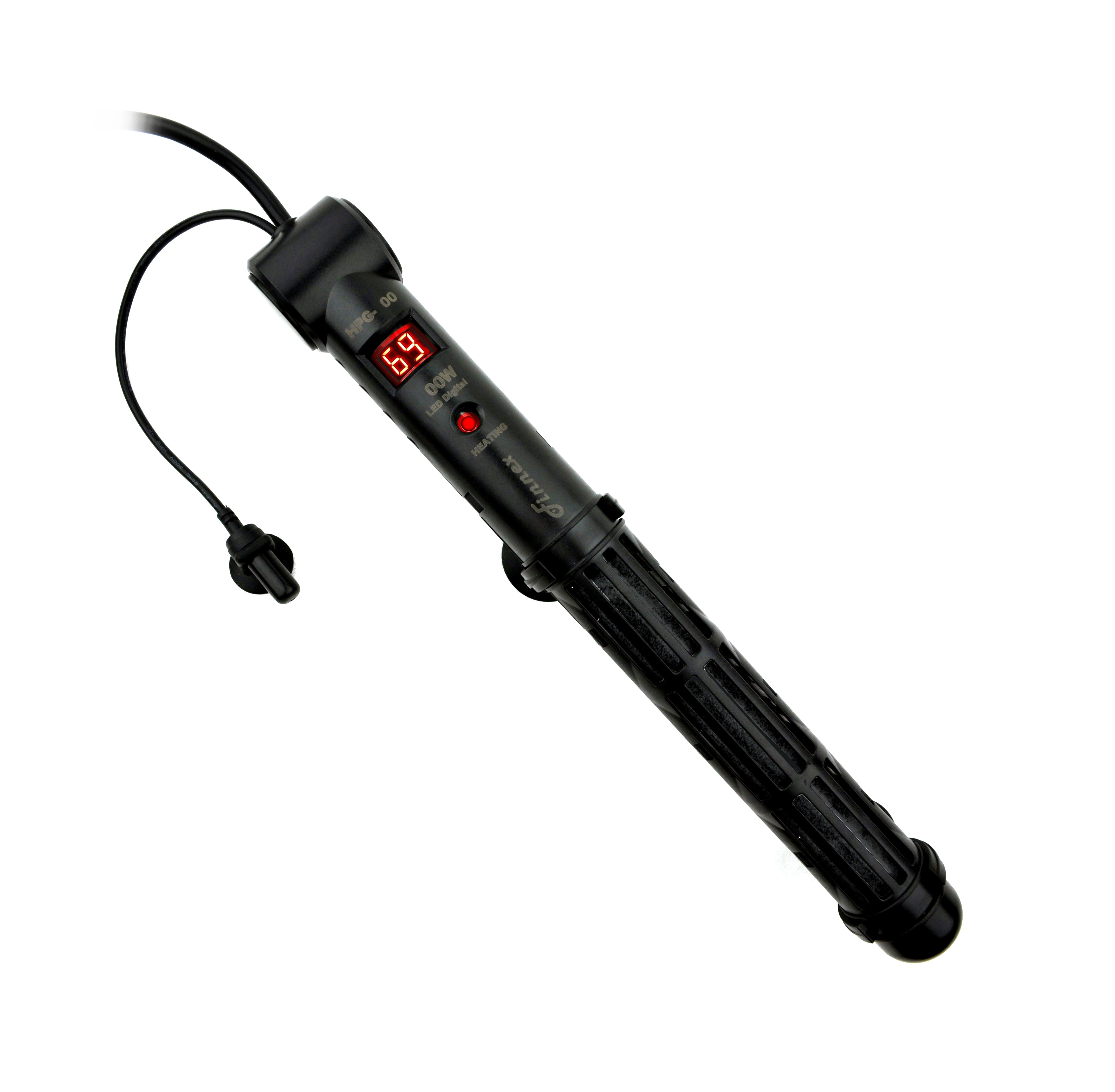
Finnex describes the HPC family as a 2 mm quartz-glass heater behind a high-temperature-resistant guard. A remote sensor in the aquarium sends temperature information to the digital controller, while the display and adjustment button sit on the power cord. The manufacturer also lists temperature-setting memory and says the sensor cuts power if it becomes exposed to air after the water drops. This combines a guarded glass element with control and sensing features, but the sources give no model-specific numerical tolerance or independently measured stability figures. “Low variance” remains manufacturer wording.
Finnex instructs the user to clean and verify the out-of-water sensor every 30 days and not to operate the heater if that sensor does not work. That shutoff feature is a protective response, not permission to run the element dry or let its placement become an afterthought. The same family page says the heater must operate in water above 150 ppm TDS. The threshold is an explicit condition worth checking for the intended water; it does not itself certify the heater for a named freshwater or saltwater environment.
Installation and electrical details to confirm
The linked PDF calls itself an HPC heater-series manual through Finnex's instructions index, but the retrieved two-page file is only a specifications chart. It does not explain full immersion, the orientation or depth of the element, clearance, guard removal, sensor mounting, cord routing, or whether the unit may be installed inline with filter plumbing. The family page describes a sensor in water and a controller outside the tank; that alone does not establish every installation condition needed to call the device fully submersible. The sources inspected also do not expressly name freshwater or saltwater approval.
Likewise, “2.70 A (115 V)” records the table's stated current reference; it should not be expanded into an assumed supply range, 60 Hz rating or certification claim. Check the actual label and exact package instructions before installation. The quartz-glass body has a guard, but Finnex does not describe it as shatterproof. A guard can reduce incidental contact with the element; it is not a body-material guarantee.
What this review can—and cannot—help decide
The HPC-300 assessment can help identify the exact 300 W line in a collection that also includes distinct 100 W and 200 W configurations. Its relevant published points are an 80–100-gallon band, 13.75-inch heater length, 68–92°F control range, and 2.70 A reference at 115 V. The finder intentionally does not recommend it, because it cannot enforce the 80-gallon floor and several installation and water-type details remain undocumented in the inspected primary material.
The Shop page assigns one generic heater photograph to all three wattages, and the visible marking does not identify the HPC-300. No shared photo or table is presented as exact model imagery. Before considering this model, confirm HPC-300 and UPC 850006562268 on the package; verify the 80–100 gallon instructions, the 68–92°F setting range, the actual electrical label, the complete mounting directions, the TDS-above-150-ppm condition and the recurring sensor check. A separate thermometer remains necessary to judge actual water temperature. This page makes no claim of having tested whether the heater maintains any setpoint or of knowing its present stock or price.
Key specifications
Key details at a glance
| Rated heater power | 300 W |
|---|---|
| Manufacturer aquarium rating | 100 US gal |
| Lowest thermostat setting | 68°F |
| Highest thermostat setting | 92°F |
| Temperature control | Adjustable thermostat |
| Heater length | 13.75 in |
Use the exact model’s instructions for operating limits, supplied equipment and version differences.
Paper, software and setup details
Manual-recommended aquarium range
80–100 US gal
Sources for this review
Sources for this assessment
Check the complete aquarium setup
Use the finder to compare documented tank size, water type, installation and temperature-control fit. A match does not guarantee the keeper's species-specific target or measured performance.