
Your needs, this model
Does it fit your priorities?
Will the M100 suit a 30-gallon aquarium?
Fluval rates this 100W model for aquariums up to 30 US gallons (100 L), but that is a maximum rating rather than a promise for every room. Its North American manual says the intended ambient-to-set temperature difference is under 18°F; cooler rooms, uncovered tanks, drafts, or nearby cooling sources can call for more heat. Verify with a separate accurate aquarium thermometer before stocking and during use.
Explore this need in the finder →Can I use the M100 in a saltwater aquarium?
Yes. Fluval identifies this M-series model for freshwater and saltwater aquariums. It is a submersible glass heater: keep the marked water range correct, do not exceed the manual's 100 cm immersion depth, and place it where water circulates freely without gravel, rocks, or decorations touching the tube.
Explore this need in the finder →What should I check before adjusting or removing the M100?
Secure it with the supplied suction-cup mounting bracket, leave it unplugged for 30 minutes after installation before powering it, and allow up to 12 hours for it to approach the selected temperature. Verify actual water temperature with an accurate thermometer; Fluval advises unplugging it for water changes or maintenance and allowing at least 30 minutes to cool before removal.
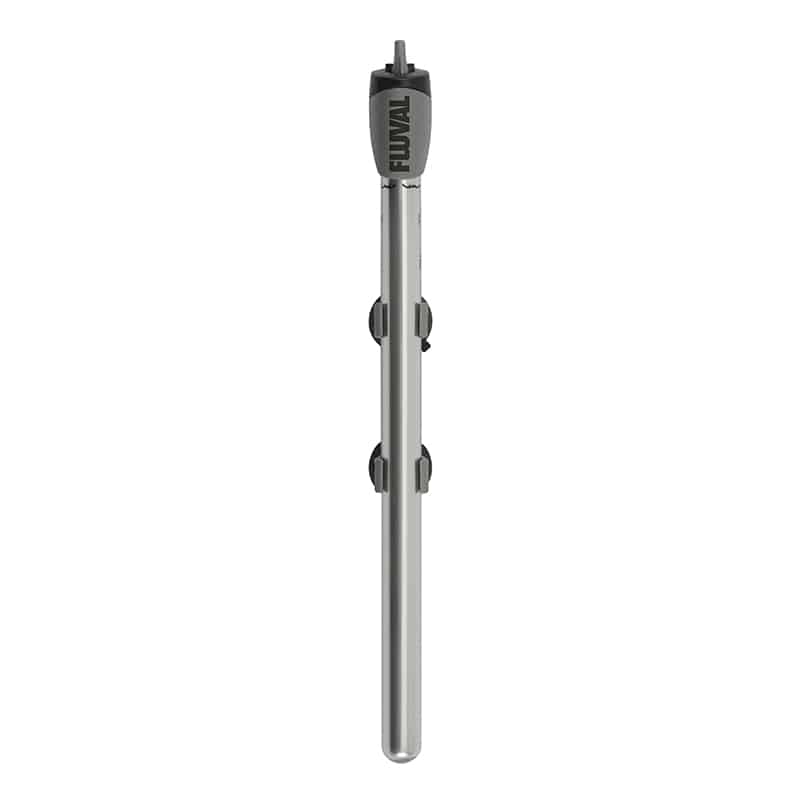
Explore this need in the finder →The Fluval M100 is a 100-watt, adjustable aquarium heater that Fluval rates for tanks up to 30 US gallons. Its defining trade is straightforward: a narrow glass tube, a temperature dial and a reflective finish, rather than an electronic display or polymer shell. This is a source-based assessment of the listed US M100 (item A782), not a hands-on performance test.
What the 30-gallon rating does—and does not—tell you
Fluval's US listing pairs 100 watts with an aquarium capacity of up to 30 US gallons (100 litres). That maximum is a starting boundary, not a guarantee that every 30-gallon setup will reach its desired temperature. The North American manual describes the heater's intended performance for an ambient-room-to-setpoint difference below 18°F. It also names conditions such as a cold room, temperature swings, an uncovered aquarium, nearby cooling sources, or pumps and filters as possible reasons a setup needs additional heating capacity.
Before treating the rating as a fit, compare the room's coldest likely temperature with the aquarium temperature you actually need, and consider the tank's cover and location. A 78°F setting in a steady 70°F room is a different heating demand from an 86°F setting in a drafty room in winter. The manual does not turn those examples into a universal watt-per-gallon formula; it says to increase heating power when the heater cannot reach the setting. Keep a separate accurate aquarium thermometer in the plan, and check actual water temperature before adding fish and throughout operation.
A dial range, not a water-temperature readout
The M100 has an adjustable thermostat with a stated setting range from 66°F to 86°F. Fluval describes its thermostat as computer-calibrated and gives it an easy-to-adjust dial, but the product page does not publish a numeric accuracy tolerance. The manual likewise instructs the owner to confirm the water temperature with a separate thermometer. So the dial is best understood as a requested setting, not proof that the aquarium water is already at that number.
The heater's light indicates when it is heating; the documentation does not describe a digital temperature display for this M-series model. If you want to inspect water temperature at a glance on the unit itself, or need an exact displayed value or a specific verified precision, look for a model whose manufacturer documentation establishes that feature. Do not infer that capability from the word “calibrated.”
Placement and routine care matter
The M100 is a fully submersible, in-tank heater for freshwater or saltwater aquariums. Secure its suction-cup bracket, keep the water between the heater's marked minimum and maximum lines, and do not exceed the manual's 100 cm immersion depth. Fluval recommends a position with free water circulation, often toward the rear near moving water. Keep gravel, rocks and decorations from touching or obstructing the glass tube.
After placing the heater, the manual says to wait 30 minutes before plugging it in so it can adjust to the aquarium water. It may take up to 12 hours to approach the selected setting. Avoid chasing a number immediately after startup: let the heater settle, then compare the aquarium thermometer and adjust only if needed. Unplug it during maintenance and water changes, and leave it unplugged to cool for at least 30 minutes before taking it out. The manual suggests removing deposits by soaking the heater tube in vinegar and rinsing it with fresh water; it specifically warns against chemical cleaners.
Glass is the important compromise
Fluval's manual identifies a glass heater tube and excludes glass breakage from the manual's warranty coverage. That is materially different from a heater with a documented shatterproof polymer housing. The M100 may suit a calm, well-arranged tank where the tube can sit clear of hardscape, but it is not the choice to assume is impact-proof around large or active fish. Fluval's current M100 page does not establish that a separate protective guard is included, so check the exact package if a guard is essential.
The reflected finish may make the tube less visually conspicuous against its surroundings, but it does not alter the installation limits or protect the glass from impact. The manual also says the power cord is not replaceable; a damaged cord means the appliance should be discarded rather than repaired at home.
How the M100 differs from the other M sizes
The M100 is the 100-watt member of a five-size line, not an all-purpose review of every M heater. Fluval's US comparison lists the M50 at 50 watts for up to 15 gallons, the M150 at 150 watts for up to 45 gallons, the M200 at 200 watts for up to 65 gallons, and the M300 at 300 watts for up to 80 gallons. Their listed tube lengths also differ: 11 inches for M50 and M100, 13 inches for M150 and M200, and 15 inches for M300. Each capacity and length is a separate fit question; choosing a neighboring model does not make the M100 a higher-capacity heater.
Who should shortlist it?
Consider the M100 when the aquarium is no larger than Fluval's 30-gallon rating, its 66–86°F dial range includes the keeper's independently established target, freshwater or saltwater compatibility is needed, and a glass submersible heater fits the available clearance. Look elsewhere if the installation needs to be inline with an external filter, the aquarium volume exceeds 30 gallons, an impact-resistant casing is essential, or a digital readout or verified temperature tolerance is a must. For a colder room or an exposed tank, compare capacity against the actual ambient-to-target difference rather than relying on the tank-size label alone.
Bottom line: the M100's strengths are a modest, clearly stated 30-gallon ceiling, adjustable 66–86°F control, and freshwater/saltwater support. Its tradeoffs are equally practical: glass construction, no documented numeric accuracy, and conditional heating capacity. Confirm the exact A782 package, allow the installation and temperature to stabilize, and trust a separate thermometer over the dial when checking aquarium water.
Key specifications
Key details at a glance
| Rated heater power | 100 W |
|---|---|
| Manufacturer aquarium rating | 30 US gal |
| Lowest thermostat setting | 66°F |
| Highest thermostat setting | 86°F |
| Temperature control | Adjustable thermostat |
| Supported water types | freshwater / saltwater |
| Installation route | Fully submerged, in-tank |
| Heater length | 11 in |
| Electrical supply | 120 V |
| Line frequency | 60 Hz |
Use the exact model’s instructions for operating limits, supplied equipment and version differences.
Sources for this review
Sources for this assessment
Check the complete aquarium setup
Use the finder to compare documented tank size, water type, installation and temperature-control fit. A match does not guarantee the keeper's species-specific target or measured performance.