
Your needs, this model
Does it fit your priorities?
What is the T300’s stated aquarium maximum?
Fluval lists T300 item 14884 / UPC 015561148849 at 300 W for aquariums up to 80 US gallons / 300 L, with a 14-inch listed length. The next-lower T200 is rated to 65 gallons and is listed at 12.5 inches. The bigger label does not guarantee a given tank’s heat-up result or temperature uniformity.
Explore this need in the finder →Does 300 W guarantee the T300 will heat any 80-gallon tank?
No. Fluval warns that additional heating capacity may be needed when room temperature is more than 10°F / 6°C below the selected setting; the manual also cites covers, circulation and nearby cooling sources as variables. It suggests upgrading or adding another heater if the target is not reached. Check the actual tank with a thermometer rather than treating 80 gallons as a performance guarantee.
Explore this need in the finder →Does Fluval documentation agree on T300 saltwater use?
No. The North American T-Series manual says fresh water only, while a separate Fluval English-language regional page for item 14884 / UPC 015561148849 describes fresh and saltwater use. The US product page warns about electrical equipment around salt water. Because these manufacturer statements conflict, this review and matcher support freshwater only and leave saltwater unresolved for the US edition.
Explore this need in the finder →Research-based model assessment · US configuration
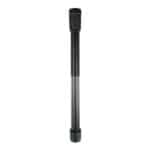
The Fluval T300 is the highest-wattage model in the currently listed T Series: 300 W, item 14884, UPC 015561148849, rated by Fluval for aquariums up to 80 US gallons (300 L). Fluval lists it at 14 inches (35.5 cm), longer than the 10.5-inch T50/T100 and 12.5-inch T150/T200. Its published rating is the largest in this family, but “largest” is not the same as best for every aquarium. This review evaluates the manufacturer’s description; it is not a product test.
What changes at the top of the family
The T300 adds 100 W over the T200, raises the listed capacity from 65 to 80 gallons, and grows from 12.5 to 14 inches. The capacity step is smaller than the wattage increase suggests, illustrating why wattage alone is a poor shortcut. The T150 and T200 also share a listed length despite different ratings. Reserve clearance around the T300’s longer body and room for water circulation.
The US family table identifies the exact T300 as item 14884 and UPC 015561148849, at 300 W for 120 V / 60 Hz and up to 80 US gallons / 300 L. It also shows a 230–240 V / 50 Hz version. Confirm the US electrical edition from the product label; a shared series name or wattage does not mean that the regional plug and supply match.
Controls and heat-status lighting
Like the other T models, the T300 uses a large dial with a stated 72–90°F (22–32°C) adjustment range. Its 360-degree indicator ring is red while the heating function is engaged and blue when the selected temperature is reached. The ring communicates heating state, not a numeric whole-tank temperature. Fluval describes its control as electronic and its monitoring as continuous, but the sources do not give a numerical accuracy tolerance. An independent thermometer is needed to verify the aquarium’s water temperature; the indicator color is not a substitute.
Compared with a fixed-preset design, the T300 offers an adjustable setting; compared with a heater that shows a numeric temperature, it offers less direct reading information. The range itself does not tell an owner what target is appropriate for fish, plants, corals or invertebrates. Establish that from appropriate care guidance separately. The heater cannot cool water if the aquarium is already warmer than the dial setting.
Fit, safe installation and upkeep
Fluval describes the T300 as fully submersible, mountable vertically or horizontally, and supplied with brackets and suction cups. Its North American manual says the heater must be underwater at least to its marked minimum level, but not deeper than 1 m (39.5 in). It must never run out of water. The manual identifies a glass heater casing; a heater guard is described as adding protection against accidental breakage, not as making the T300 shatterproof. Verify that the exact package includes the guard if you rely on it, and inspect the glass tube before use. The source lists the spacer kit as optional, so do not assume it is in every package.
Leave the tube clear of gravel, rocks and decorations and allow free water circulation. The manual suggests positioning it near water movement and waiting 30 minutes after submerging it before plugging it in. It may take up to 12 hours for the aquarium to reach the desired setting; the instructions say to wait before changing the dial. Maintain the required water level as evaporation occurs, use a drip loop, and unplug equipment before putting hands in the tank. After unplugging the T300, let it cool for at least 30 minutes before removal. Fluval’s automatic cut of power in the absence of water is a safety measure against overheating, not a normal dry-run mode.
Capacity and water-type limitations
Fluval’s support material says that a room temperature more than 10°F (6°C) below the chosen setting may require additional heating capacity. A missing aquarium cover, temperature swings, pumps and filters, and nearby cooling sources are also named in the manual as factors. If the setting is not reached, the instructions suggest increasing power or adding a second heater. Thus, an 80-gallon listing is an upper reference rather than a guaranteed outcome across room conditions, covers, flow patterns, and tank shapes. This assessment contains no wattage calculation or performance test for a particular setup.
The manufacturer’s water-type information is inconsistent across sources. The North American manual says to use fresh water only; Fluval’s US product page says to take extreme caution with electrical equipment around salt water; a different English Fluval T300 page describes use in fresh and saltwater aquariums. This review does not treat the latter as sufficient to override the North American instruction for the US configuration. Freshwater is the supported plan here; a saltwater aquarist should seek confirmation for item 14884 specifically before relying on it.
When it merits consideration
The T300 may suit a freshwater aquarium within the manufacturer’s 80-gallon ceiling if its 14-inch length, full-submersion installation and 72–90°F dial range fit the layout and care plan. For a smaller tank, the T200 has a shorter listed body and a 65-gallon rating; T150 is shorter still, rated to 45 gallons. These alternatives are not performance guarantees either. The usable volume, the coldest normal room, water movement and available clearance deserve attention before deciding that the top model is needed.
Before purchase, match item 14884 and UPC 015561148849 and confirm 120 V / 60 Hz. Check the product label, package, guard and optional spacer, 14-inch body, waterline, and seller return terms for damaged glass. Use an independent thermometer after setup; price, availability and retailer ratings were not verified.
Sources: Fluval USA T300 product page, T Series family comparison, T Series FAQ, the North American manual, and Fluval’s separate English T300 listing documenting the conflicting saltwater description. Exact T300 image bytes remain an open gap.
Key specifications
Key details at a glance
| Rated heater power | 300 W |
|---|---|
| Manufacturer aquarium rating | 80 US gal |
| Lowest thermostat setting | 72°F |
| Highest thermostat setting | 90°F |
| Temperature control | Adjustable thermostat |
| Supported water types | freshwater |
| Installation route | Fully submerged, in-tank |
| Heater length | 14 in |
| Electrical supply | 120 V |
| Line frequency | 60 Hz |
Use the exact model’s instructions for operating limits, supplied equipment and version differences.
Sources for this review
Sources for this assessment
Check the complete aquarium setup
Use the finder to compare documented tank size, water type, installation and temperature-control fit. A match does not guarantee the keeper's species-specific target or measured performance.