
Your needs, this model
Does it fit your priorities?
Will HeatUp 25 cover an aquarium at its published size limit?
OASE gives this exact 25 W SKU a 25 L technical maximum and also states up to 10 US gallons. Those rounded/source forms differ; this library uses the lower litre conversion, 6.6 US gal, as the conservative maximum. That is not a warm-up or cold-room guarantee. Check actual water volume, room-to-water difference, lid, circulation and livestock needs.
Explore this need in the finder →Can HeatUp 25 be used for saltwater and where does it install?
OASE lists freshwater and saltwater suitability and a fully submerged in-tank holder. No external-filter configuration is established by the reviewed model page. Do not put it into unlisted filter plumbing.
Explore this need in the finder →Is HeatUp 25 adjustable for the intended temperature setting?
OASE documents a 66–90°F setting scale. A secondary post-calibration adjustment is described as ±2°F in one US feature block and ±3°C in other product copy; neither is an accuracy tolerance, a measured water reading or a stated degree-by-degree step. Confirm actual water temperature with a separate thermometer and set a species-appropriate target independently. Its quartz tube is not documented as shatterproof. Verify the exact heater label: US technical table says 115 V / 50–60 Hz, while the product narrative says 230 V.
Explore this need in the finder →The OASE HeatUp 25 is the smallest wattage in the U.S.-listed HeatUp family: a 25 W, dial-adjustable quartz-glass heater with a 66–90°F scale and a manufacturer table rating of 25 L. The U.S. product copy also describes it as suitable for aquariums up to 10 gallons. Those two capacity expressions do not agree when litres are converted to U.S. gallons, so this review uses the lower figure—about 6.6 U.S. gallons—as the conservative matching ceiling. This is a source-based assessment of SKU 33798, not a hands-on test or a promise about warming any particular tank.
Where the smallest HeatUp fits
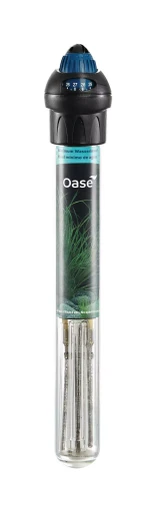
At 25 W, 23 mm in diameter and 205 mm (about 8.1 inches) tall, this is the shortest HeatUp size. It may be easier to place in a compact aquarium than the longer 100–400 W bodies, but the heater still needs enough vertical space to respect its minimum-immersion mark and to sit where water circulates. OASE lists freshwater and saltwater use, continuous operation, a holder with suction cups, a power indicator, and a three-year warranty. The catalog image is a product identity view, not a scale reference, and its body does not show a readable wattage label.
Its published upper capacity is not a room-temperature calculation. A small tank in a cold room, one with a large temperature gap, an uncovered top, or little circulation may ask more of a heater than a maximum-size label implies. This library does not invent a lower minimum-tank capacity for the model because the official table states only an upper “up to” figure. If the aquarium is below that ceiling, check the instructions and the livestock’s needs rather than assuming a smaller tank is automatically a suitable pairing.
Adjustable control, with an important wording conflict
OASE describes a temperature scale from 66°F to 90°F and a secondary adjustment for post-calibration. Its U.S. site uses two different phrasings for that adjustment: one feature block says ±2°F, while a separate technical feature says ±3°C. These are not a claim that the thermostat is accurate to either tolerance, and they do not establish a particular adjustment increment. A visible indicator shows when heating is active; it is not a measured-water-temperature display. The adjustment range should therefore be treated as the setting range only. Use an independent aquarium thermometer to check actual water conditions and verify a species-appropriate target with a reliable husbandry source.
Confirm the electrical label before use
SKU 33798 appears in OASE’s U.S. HeatUp family selector, and the exact product specification table says 115 V, 50–60 Hz. Yet the page’s narrative description says 230 V, including under the U.S.-oriented page title. That is a material source conflict, not a detail to guess away. The matcher uses the exact technical-table value for this U.S. edition, but buyers should inspect the carton and heater nameplate before plugging it into U.S. mains. If the physical unit says 230 V, do not use it on a U.S. outlet; pause and ask OASE or the seller to identify the exact voltage edition. No offer price or current stock state is treated as stable evidence here.
Quartz is not a shatterproof promise
The manufacturer describes a quartz-glass tube and says it withstands at least twice the temperature of standard glass. That is a relative thermal-resistance statement, not an impact rating, a guarantee against breakage, or a documented “shatterproof” body. OASE also describes bimetal thermostat control, an indicator light, and a thermal shutoff switch. The accessible product facts do not establish a separate dry-run sensor or its trigger conditions, so the safety discussion should not be expanded beyond those named features. Follow the exact manual for water depth, placement, electrical routing and cool-down steps; do not infer those details from a product photograph.
Who should compare it
Consider the HeatUp 25 when a documented adjustable range, fresh-or-marine suitability and the shortest listed HeatUp length matter, and the aquarium is no larger than the conservative 6.6-gallon screen. Compare the 50 W size rather than extrapolating upward if more wattage is needed, and check actual clearances before choosing either. The 25 W model does not have a documented external-canister installation route in the reviewed product evidence; its included holder is an in-tank setup. Neither a source-based match nor a wattage label certifies a safe livestock temperature or measured heating performance.
Questions to settle before choosing
- Is the actual aquarium volume at or below the conservative 6.6-gallon ceiling, and is the room-to-water temperature difference modest enough for this published maximum to be a useful starting point?
- Will an approximately 8.1-inch-long heater fit below the waterline mark and in a place with circulation, without crowding animals or maintenance access?
- Does the physical heater label confirm 115 V for the intended supply, and is an ordinary quartz-glass body acceptable when the maker has not called it shatterproof?
Key specifications
Key details at a glance
| Rated heater power | 25 W |
|---|---|
| Manufacturer aquarium rating | 6.6 US gal |
| Lowest thermostat setting | 66°F |
| Highest thermostat setting | 90°F |
| Temperature control | Adjustable thermostat |
| Supported water types | freshwater / saltwater |
| Installation route | Fully submerged, in-tank |
| Heater length | 8.1 in |
| Electrical supply | 115 V |
Use the exact model’s instructions for operating limits, supplied equipment and version differences.
Sources for this review
Sources for this assessment
Check the complete aquarium setup
Use the finder to compare documented tank size, water type, installation and temperature-control fit. A match does not guarantee the keeper's species-specific target or measured performance.