
Your needs, this model
Does it fit your priorities?
Does the Jäger 200 W rating include a 106-gallon tank?
The Type 3617 manual gives a maximum of 106 US gallons, so 106 gallons is within the matching screen and 107 gallons is beyond it. Its lower approximate volume band and actual room conditions also matter; the capacity line is not a temperature-performance guarantee.
Explore this need in the finder →Can the Jäger 200 W be considered for marine water?
EHEIM describes the classic thermocontrol family for freshwater and marine use, and Type 3617 is the 200 W row in the manual. Check that the working volume fits its stated maximum and follow the vertical-placement, minimum-water-line and 0.5 m immersion limits in the exact manual.
Explore this need in the finder →Is 200 W Jäger adjustable to 93°F?
Yes. The classic thermocontrol manual specifies a 65–93°F selector range, so 93°F is the upper documented setting. The red light indicates heater operation, not a measured aquarium temperature; confirm the actual water reading separately and choose an appropriate livestock target using husbandry information.
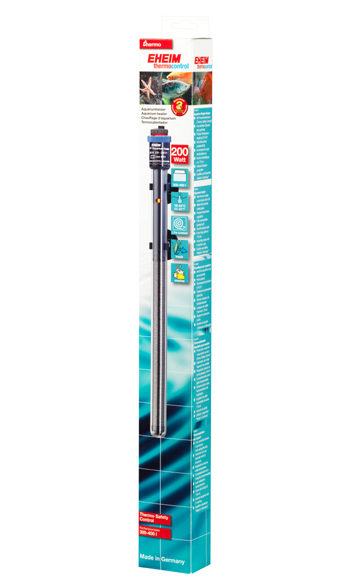
Explore this need in the finder →The EHEIM Jäger 200 W reviewed here is the classic analog thermocontrol Type 3617, matched to US retail UPC 720686361393. Its official manual lists a 79–106 US-gallon capacity band, a 120 V / 60 Hz North American supply group and a 406 mm heater body. Do not confuse it with the 200 W thermocontrol e, which is a distinct electronic model. This review compares the documented specifications and operating constraints; it does not claim personal use, test data or measured heating results.
A larger tank rating comes with a longer tube
Type 3617 is rated for approximately 300–400 L, or 79–106 US gallons. The maximum matters at the finder boundary: 106 gallons stays within the manual's screen and 107 is outside it. The stated lower range also matters. The matcher does not declare a 200 W heater ideal for every volume below 106 gallons; the appropriate power depends on actual water volume, room conditions, desired temperature change, tank cover and circulation.
EHEIM frames the family sizing table around a closed aquarium, a 21°C / 70°F room and water temperature up to 26°C / 79°F. If those assumptions do not resemble the setup, the 106-gallon number is not a performance guarantee. Ask EHEIM for model-specific advice when the room is cold or the temperature gap is large, and use an independent thermometer once the aquarium is running.
The Type 3617 body is 36 mm across and 406 mm long, about 16 inches, noticeably more demanding of clear vertical space than the Jäger 150 W at 345 mm. The next 250 W model grows to 452 mm and is rated to 159 gallons. Those are meaningful differences in tank fit and stated capacity even though all three use the same analog control family. Measure the space between the water line, tank rim and substrate, and consider how the unit can be withdrawn for maintenance.
What is included in the control specification
The analog temperature ring covers 65–93°F. EHEIM states ±0.9°F control accuracy and provides a recalibration step using an accurate thermometer. The red status light means that heating is active; it does not provide a numerical temperature reading. An adjustable dial may be helpful when a keeper needs to choose a setpoint, but it does not guarantee the entire aquarium has reached that setting. A desired value must first be chosen for the specific animals and then checked in the actual water.
EHEIM describes its special laboratory glass as a heat shield and says the material is impact-resistant. Neither point establishes a shatterproof body. A separate cage is not confirmed in the reviewed sources. Plan the placement so that rocks, décor and routine cleaning tools do not strike the tube; do not treat a glass heater as a rugged object.
Vertical, fully submerged use has limits
The manufacturer manual calls for a vertical position where water flows briskly and identifies an included double suction-cup holder. The heater is fully submersible, but the water level must stay above the MIN mark and immersion cannot exceed 0.5 m. The 406 mm body needs enough height for that marked line to remain under water while leaving the cord and top control accessible. This configuration is intended for inside the aquarium; no inline external-filter installation plan is documented.
For initial setup, let the unplugged heater sit in aquarium water for 20–30 minutes before energizing it. Route a drip loop, check the exact voltage label, never switch the unit on outside water, and do not pair it with an additional timer or external control system. Switch off before reaching into the tank and let the heater cool in the water before removing it. These instructions are more restrictive than simply placing a 200 W label beside a tank.
Offer and model checks
The retailer's exact Jäger 200 W page gives the UPC used to identify this configuration, and EHEIM's model page/manual distinguish Type 3617 from the electronically controlled e200. The official Type table identifies the family North American 120 V / 60 Hz supply; still confirm that marking on the item itself. The product page's global pack and electrical edition should not be assumed from a seller's shortened title.
The exact 200 W retailer photo was inspected and visibly says 220–240 V, so it is rejected as the image for this North American product. No alternate photo is integrated unless its exact electrical version is documented. Keep Type 3617 on a research shortlist only when the actual aquarium falls within the size guidance, a roughly 16-inch vertical glass tube fits, and the keeper accepts analog adjustment and external temperature checks. It is not a confirmed shatterproof-body or filter-inline choice. Verify the package contents and warranty for the exact item. This review makes no statement about current availability, price, customer ratings or independently measured performance.
Sources: EHEIM's thermocontrol 200 model page and Types 3611–3619 operating manual; the US retailer listing identifies UPC 720686361393.
Key specifications
Key details at a glance
| Rated heater power | 200 W |
|---|---|
| Manufacturer aquarium rating | 106 US gal |
| Lowest thermostat setting | 65°F |
| Highest thermostat setting | 93°F |
| Temperature control | Adjustable thermostat |
| Supported water types | freshwater / saltwater |
| Installation route | Fully submerged, in-tank |
| Heater length | 16 in |
| Electrical supply | 120 V |
| Line frequency | 60 Hz |
Use the exact model’s instructions for operating limits, supplied equipment and version differences.
Sources for this review
Sources for this assessment
Check the complete aquarium setup
Use the finder to compare documented tank size, water type, installation and temperature-control fit. A match does not guarantee the keeper's species-specific target or measured performance.