
Your needs, this model
Does it fit your priorities?
Does the Jäger 300 W rating include a 260-gallon tank?
The Type 3619 manual gives a maximum of 260 US gallons, so 260 gallons is within the matching screen and 261 gallons is beyond it. Its lower approximate volume band and actual room conditions also matter; the capacity line is not a temperature-performance guarantee.
Explore this need in the finder →Can the Jäger 300 W be considered for marine water?
EHEIM describes the classic thermocontrol family for freshwater and marine use, and Type 3619 is the 300 W row in the manual. Check that the working volume fits its stated maximum and follow the vertical-placement, minimum-water-line and 0.5 m immersion limits in the exact manual.
Explore this need in the finder →Is 300 W Jäger adjustable to 93°F?
Yes. The classic thermocontrol manual specifies a 65–93°F selector range, so 93°F is the upper documented setting. The red light indicates heater operation, not a measured aquarium temperature; confirm the actual water reading separately and choose an appropriate livestock target using husbandry information.
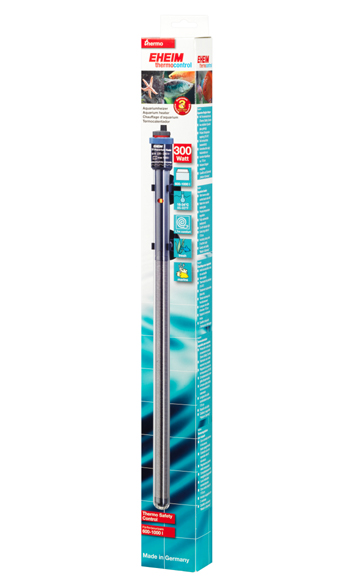
Explore this need in the finder →The 300 W EHEIM Jäger is Type 3619 in the classic thermocontrol family and is matched here to the US retailer UPC 720686361591. It is the largest wattage in the nine-size Jäger family. The available manufacturer documents disagree slightly about its US-gallon ceiling: one official Type manual gives 159–260 gallons, while another EHEIM family document and a retailer copy state 264 gallons for the same 600–1,000 L band. To avoid promising the higher value, this assessment screens against the lower explicit 260-gallon maximum and records the conflict. It is research-based analysis, not a test of heat output.
A conservative capacity screen for the largest size
The current operating manual linked from EHEIM's Type family page assigns 300 W / Type 3619 a 600–1,000 L range and an explicit 159–260 US-gallon range. Under that table, 260 gallons is within the rating and 261 is over it. The alternative 264-gallon figure appears in another official Type-family copy and in retailer text, but the 260-gallon cell is the conservative, directly stated US-gallon figure used for matching here. A source disagreement does not establish which copy is a newer package insert; check the manual supplied with the exact heater or ask EHEIM before relying on a value above 260 gallons.
The model is also associated with an approximate lower volume of 600 L / 159 gallons. The finder checks only the stated maximum; a positive result for a much smaller aquarium is not a wattage recommendation. EHEIM says the family rating assumes a closed tank, 21°C / 70°F room temperature and desired water up to 26°C / 79°F. Cold rooms, an open top, circulation and the gap between room and water all matter. For a large aquarium, ask the manufacturer whether and how to distribute heating load; do not assume that simply adding another unit is suitable.
Type 3619 has a 506 mm / roughly 19.9-inch body, the longest in this classic family. That physical dimension is a decision point rather than a footnote: the tube must fit vertically, remain under the minimum water mark, avoid contact with hardscape and still be removable. Compare it with Jäger 250 W / Type 3618, which is 452 mm long and has the lower 159-gallon maximum. EHEIM's electronic thermocontrol e300 is a different Type and product, not an equivalent name for this analog model.
Manual dial and temperature checks
EHEIM documents a 65–93°F analog selector range, stated ±0.9°F control accuracy and recalibration through comparison with an accurate separate thermometer. The red lamp shows that the heater is working; it does not show a measured temperature. An upper-end setting is technically within the scale, but it is not a husbandry recommendation. Select a safe target for the animals independently, verify the water in the aquarium and monitor it under real operating conditions.
The glass casing is described as a heat shield and as impact resistant, not shatterproof. The sources do not establish an included cage. In a large aquarium where the heater may be near rocks, pump intakes or maintenance equipment, placement and protection from direct impact are important. Do not confuse the dry-run safety feature with permission to operate the rod out of water.
Installation, electrical version and package check
Type 3619 is fully submersible and intended for vertical in-tank placement in brisk water flow. Use the double suction-cup holder, keep water above the MIN mark, and stay within the manual's 0.5 m immersion maximum. It is not a documented inline heater. The 506 mm body and holder need ample height and access. For start-up, the manual calls for a 20–30 minute unplugged acclimation in aquarium water; it also requires a drip loop, says not to use a separate timer or control system, and directs users to switch off and cool the heater in water before removal. Never energize it outside the tank.
The official Type manual includes 3619 in the North American 120 V / 60 Hz group, and the retailer listing provides the exact US UPC. Still check the label on the physical unit and the instructions inside the package. The exact 300 W retailer package photograph says 220–240 V, so it is rejected as a US product image. No image of a different electrical edition, sibling model or imagined heater is used here.
Type 3619 merits comparison only if the measured working volume, actual heat-loss conditions, available vertical space and analog controls suit the aquarium. Its high wattage does not establish faster or more stable heating in a particular room. It is not a shatterproof-body or external-filter choice. Review the exact model and included parts, confirm the 260-versus-264 documentation question with the manufacturer if relevant, and use a separate aquarium thermometer. No price, availability, ownership, customer experience or hands-on test is claimed.
Sources: EHEIM's thermocontrol 300 model page and Types 3611–3619 operating manual; the alternate official family manual and the US retailer listing are retained in research for Type/UPC cross-check and capacity discrepancy documentation.
Key specifications
Key details at a glance
| Rated heater power | 300 W |
|---|---|
| Manufacturer aquarium rating | 260 US gal |
| Lowest thermostat setting | 65°F |
| Highest thermostat setting | 93°F |
| Temperature control | Adjustable thermostat |
| Supported water types | freshwater / saltwater |
| Installation route | Fully submerged, in-tank |
| Heater length | 19.9 in |
| Electrical supply | 120 V |
| Line frequency | 60 Hz |
Use the exact model’s instructions for operating limits, supplied equipment and version differences.
Sources for this review
Sources for this assessment
Check the complete aquarium setup
Use the finder to compare documented tank size, water type, installation and temperature-control fit. A match does not guarantee the keeper's species-specific target or measured performance.