
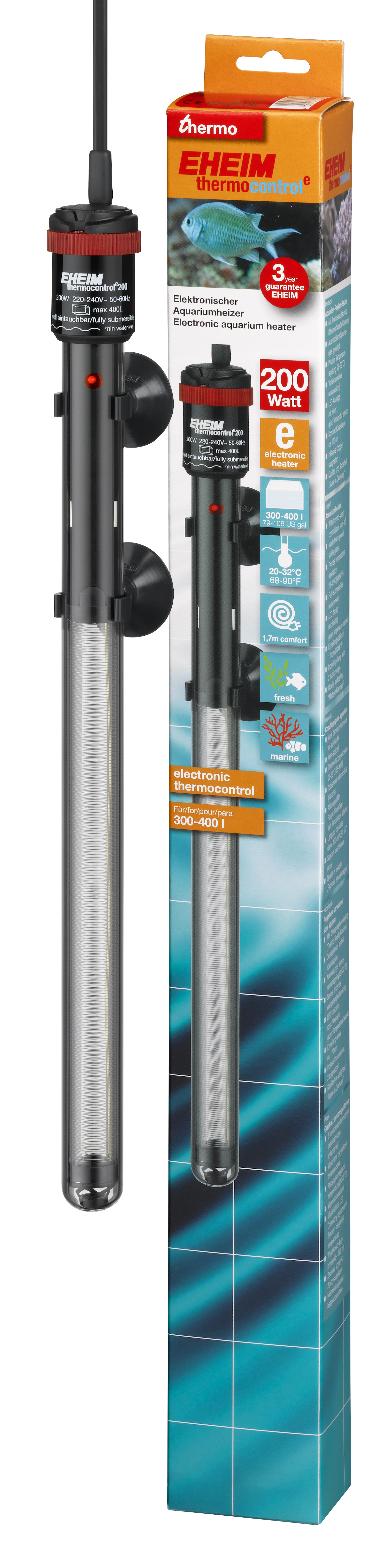
Your needs, this model
Does it fit your priorities?
Can the EHEIM e 200 be considered for a 100-gallon saltwater aquarium?
EHEIM lists the 200 W Type 3637 for approximately 300–400 L and up to 400 L; its North American manual converts that maximum to 106 US gallons. A 100-gallon tank is under the published ceiling, and the product page lists freshwater and marine use with adjustable control through 90°F. The heater still needs vertical space for its 396 mm / 15.6-inch body, strong water flow and an exact 120–127 V / 60 Hz match; the rating alone cannot predict heat-up or holding performance.
Explore this need in the finder →Does the e 200 rating cover 107 gallons?
No. Type 3637 is rated by the manual to a maximum of 106 US gallons, so 107 exceeds that inclusive limit. Do not stretch this figure because the model is 200 W; the larger e 250 and e 300 have separate Type numbers, bodies and capacity ranges. A match below the ceiling is only a published-capacity screen, not proof that the room and tank conditions suit one heater.
Explore this need in the finder →How does Type 3637 differ physically from the adjacent EHEIM e sizes?
The e 200 is 200 W, rated up to 106 US gallons and 396 mm / about 15.6 inches high. The smaller e 150 reaches 79 gallons and is about 13.2 inches high; the e 250 reaches 159 gallons and is about 17.4 inches high. All three use the family’s adjustable 68–90°F thermostat, so actual tank volume and vertical clearance—not wattage alone—separate these configurations.
Explore this need in the finder →The EHEIM thermocontrol e 200 is a 200-watt adjustable heater in the classic thermocontrol e family. This assessment covers Type 3637, not Fluval's E200 or EHEIM's Wi-Fi-controlled thermocontrol+ e. The North American manual rates it to 106 US gallons; this is source-based research, not a performance test.
The e 200 sits between the 79- and 159-gallon sizes
Type 3637 is rated to 106 US gallons; EHEIM's approximate range begins at 300 L / 79 gallons. Its 396 mm (15.6 in) body falls between the e 150 (335 mm, up to 79 gallons) and e 250 (442 mm, up to 159 gallons). Confirm the Type, UPC and mounting height rather than comparing wattage alone.
The 106-gallon ceiling is a screen, not a guarantee in a cool room, and the source does not supply a heat-up curve. Consider actual water volume, room temperature, cover and circulation. The lower 79-gallon figure is context, not a hard minimum in this finder's rules.
An adjustable thermostat, not a live numeric readout
EHEIM specifies 20–32°C adjustment, expressed in the English manual as 68–90°F, with a manufacturer-stated control accuracy of ±0.5°C (about ±1°F). A red/green indicator shows whether the heater is actively heating or has reached its selected setting. The light is a status signal; it does not display a measured water temperature. Nor does the stated control accuracy guarantee that all parts of an aquarium have the same temperature. Confirm a biologically suitable setpoint from appropriate care guidance and use a separate aquarium thermometer to check water in the tank.
At 91°F the e 200 is outside its range. Fluval E has a 93°F upper setting and digital display, while EHEIM uses a lamp and stops at 90°F; neither is an independent whole-tank thermometer.
Vertical mounting and water marks matter more than the wattage label
The manual calls for the heater to be installed vertically inside the aquarium, fully below the surface to at least the MIN WATER LEVEL marking, and in an area with strong flow. Its double suction holder belongs away from the heating zone and indicator light. The unit is about 15.6 inches tall and 1.4 inches wide, so measure the usable height in the tank before deciding that a nominal 106-gallon match will physically work. The manual also tells the owner to observe a maximum immersion depth, but its English directions do not provide a numeric maximum. The body length should not be substituted for a missing depth value.
Thermo Safety Control is protection against an accidental low-water condition, not permission to run dry. The manual also calls for a drip loop, dry plugs and sockets, unplugging before maintenance, a 30-minute in-water cool-down and inspection of the glass and fixed mains cable.
Impact-resistant glass is not a shatterproof body
EHEIM calls the coating special laboratory glass and describes it as impact resistant. That wording is narrower than saying the entire heater is shatterproof. The e 200 remains a glass-bodied immersion heater, and the source material does not establish a separate protective cage in the package. This library therefore does not match it when a documented shatterproof body is essential. Leave room between the heater and hardscape, and check the exact included parts if a guard is a requirement rather than a preference.
Check the Type, retail code and electrical label
EHEIM's product page identifies the classic e 200 as Type 3637, global product-page number 3637010 and EAN 4011708004890. The manual places Types 3631–3639 in a 120–127 V / 60 Hz North American group, while also showing a 220–240 V / 50–60 Hz version. A US retail category separately lists Thermocontrol e200 with UPC 720686005198. Those identifiers bridge a model page to a North American retail listing; the global item number is not the US UPC.
Official and retailer image candidates depict the 220–240 V edition, so none represents the North American unit here. Confirm the actual voltage label; the similarly named Wi-Fi thermocontrol+ e200 is a separate product, not Type 3637.
Who should compare the e 200?
Compare it for a fresh- or marine-water aquarium under 106 gallons when an adjustable 68–90°F setting and vertical 15.6-inch body fit. At 107 gallons or above 90°F it exceeds a published limit; the documentation does not support inline installation, a digital readout or a shatterproof body.
Bottom line: Type 3637's 106-gallon ceiling and 396 mm body separate it from e150 and e250. Verify the actual US voltage and tank temperature; no price, stock or performance test is claimed.
Sources: EHEIM's thermocontrol e 200 product page, the Type 3631–3640 operating manual, and DFW Aquarium's Eheim heater category for the retail name/UPC cross-check.
Key specifications
Key details at a glance
| Rated heater power | 200 W |
|---|---|
| Manufacturer aquarium rating | 106 US gal |
| Lowest thermostat setting | 68°F |
| Highest thermostat setting | 90°F |
| Temperature control | Adjustable thermostat |
| Supported water types | freshwater / saltwater |
| Installation route | Fully submerged, in-tank |
| Heater length | 15.6 in |
| Electrical supply | 120 V |
| Line frequency | 60 Hz |
Use the exact model’s instructions for operating limits, supplied equipment and version differences.
Sources for this review
Sources for this assessment
Check the complete aquarium setup
Use the finder to compare documented tank size, water type, installation and temperature-control fit. A match does not guarantee the keeper's species-specific target or measured performance.