
Your needs, this model
Does it fit your priorities?
Does Type 3667 fit EHEIM's published capacity screen for a 100-gallon freshwater tank?
The operating manual places Type 3667 at about 300–400 L (79–106 US gal), so 100 gallons is inside its stated upper-capacity screen. This is not a guarantee that one heater will maintain a chosen temperature in every room or flow pattern. Check model/type, North American voltage and vertical clearance, then independently verify actual water temperature.
Explore this need in the finder →Will the 200 W thermocontrol+ e accept a 91°F setting in saltwater?
EHEIM documents fresh and marine water for the thermocontrol+ e family, but its English operating manual gives 90°F as the upper setting. A 91°F request is outside that manual interval, so the finder excludes Type 3667 for that combination. Confirm an appropriate target for the livestock separately; the unit's control range is not a temperature recommendation.
Explore this need in the finder →How is the 200 W Type 3667 different from the 150 W and 250 W thermocontrol+ e?
Type 3667 is the 200 W middle size with a 386 mm (15.19 in) body and 106-US-gallon maximum. The 150 W Type 3666 is 327 mm and rated through 79 gallons; the 250 W Type 3668 is 431 mm and rated through 159 gallons. Their WLAN controls and manual setting interval are shared, but the size ratings and required installation space are not interchangeable.
Explore this need in the finder →The EHEIM thermocontrol+ e 200 is a 200 W heater with WLAN temperature adjustment and monitoring. This review concerns North American Type 3667, which is distinct from EHEIM's classic thermocontrol e200 Type 3637 and the 200 W Jäger Type 3617. The Type 3667 manual row lists an approximate 300–400 L range (79–106 US gallons) and a 386 mm (15.19 in) body. Its larger size than the 150 W plus model matters both to aquarium capacity screening and to the vertical clearance available inside the tank.
Type 3667 is the middle size, not a generic 200 W substitute
The manual's adjacent plus-family rows show four actual North American-capable wattages: Type 3666 / 150 W to 79 US gallons, Type 3667 / 200 W to 106 gallons, Type 3668 / 250 W to 159 gallons, and Type 3669 / 300 W to 264 gallons. The 200 W heater is 386 mm long and 32 mm wide. Choosing it because a tank's nominal label says “100 gallons” is not enough: use actual working water volume, consider the room-to-water temperature difference, circulation, cover and heater clearance, and treat EHEIM's published upper rating as a screen rather than a thermal performance promise.
WLAN monitoring brings setup requirements
EHEIM describes WLAN-based adjustment from a phone, tablet or computer, status indicators and optional e-mail notification after a temperature deviation. The operating manual documents 2.4 GHz WiFi and a browser-based setup through the heater's WLAN; a saved e-mail address is part of the notification configuration. It can also synchronize with specified EHEIM.digital devices. These are meaningful differences from a manual dial, but they add setup steps and do not provide active cooling. If the aquarium must be held to a narrow range, an independent thermometer remains essential; the device's settings and alerts are not a substitute for measuring actual water or checking the target with species-appropriate guidance.
One specification conflict deserves attention: the current product page says 18–32°C, while the English operating manual says 20–32°C ±0.5°C and also states 68–90°F ±1°F. Because those low endpoints differ, this review and finder use the manual's explicit Fahrenheit interval for the US version and do not widen the range based on a converted metric web figure. Check the exact supplied manual before setting a unit.
Installation, material and exact electrical version
The manual calls for vertical in-aquarium mounting, a minimum water level mark, sufficient water flow, and never operating the heater dry. EHEIM describes the unit as fully submersible, but notes that best WiFi signal reception comes when it is immersed only to the marked water level. The English instructions do not provide a numeric maximum immersion depth. The product is glass and is not documented as having a shatterproof body; verify the actual mounting points and keep the glass clear of hardscape. The thermal circuit breaker is a safeguard, not an instruction to test the heater out of water.
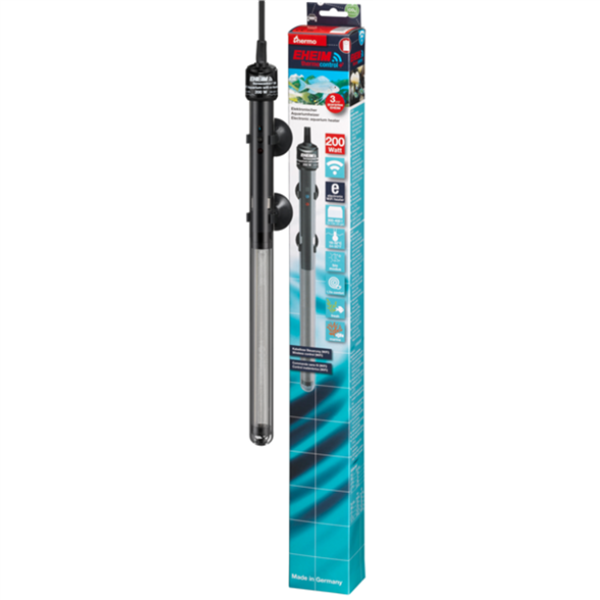
The manual assigns Types 3666–3669 a 120–127 V / 60 Hz North American supply group and also lists a separate 220–240 V group. A US retailer's listing connects Type 3667/200 W with UPC 720686011687. Check the package and heater label against the source model, output and electrical rating before purchase. The exact EHEIM gallery image identifies 200 W but visibly carries a 220–240 V label, so it remains rejected. This page instead uses the wattage-matched photo tied to the US retailer listing; no voltage label is legible there, so check the package and unit.
Bottom line: Type 3667 is a documented 200 W/106-gallon WLAN option if the tank's measured volume, manual-defined setting and 15.19-inch vertical position fit. Its distinct value is network-controlled adjustment, not an assurance that 200 W will heat every 106-gallon setup.
Sources: the EHEIM thermocontrol+ e 200 page, official Types 3666–3670 manual, and the US retailer's thermocontrol+ e model list.
Key specifications
Key details at a glance
| Rated heater power | 200 W |
|---|---|
| Manufacturer aquarium rating | 106 US gal |
| Lowest thermostat setting | 68°F |
| Highest thermostat setting | 90°F |
| Temperature control | Adjustable thermostat |
| Supported water types | freshwater / saltwater |
| Installation route | Fully submerged, in-tank |
| Heater length | 15.19 in |
| Electrical supply | 120 V |
| Line frequency | 60 Hz |
Use the exact model’s instructions for operating limits, supplied equipment and version differences.
Sources for this review
Sources for this assessment
Check the complete aquarium setup
Use the finder to compare documented tank size, water type, installation and temperature-control fit. A match does not guarantee the keeper's species-specific target or measured performance.