
Your needs, this model
Does it fit your priorities?
Does the 300 W Type 3669 cover the published maximum for a 220-gallon marine aquarium?
Type 3669 is listed for approximately 600–1,000 L (159–264 US gal), and EHEIM identifies the product line for marine water. A 220-gallon volume is inside that upper-capacity screen. Check the exact 120–127 V version, waterline mark and the 486 mm vertical clearance; the figure does not guarantee heating performance in a particular room.
Explore this need in the finder →Is 264 gallons still within the Type 3669 capacity screen, and what about 265?
The Type 3669 manual row gives 264 US gallons as its inclusive upper figure, so 264 remains inside this match screen while 265 exceeds it. EHEIM's approximate capacity is not an engineering calculation for a cold, uncovered or high-loss installation, and the actual water temperature still needs independent verification.
Explore this need in the finder →How should I compare the 300 W Type 3669 with the 250 W model?
Type 3669 adds a distinct 600–1,000 L / 159–264 US-gallon manual band and a 486 mm / 19.13-inch body; the 250 W Type 3668 is 400–600 L / 106–159 gallons and 431 mm / 16.97 inches. Both have the same documented 68–90°F control interval and WLAN family features. The 300 W label alone does not establish the right heat load or guarantee a temperature.
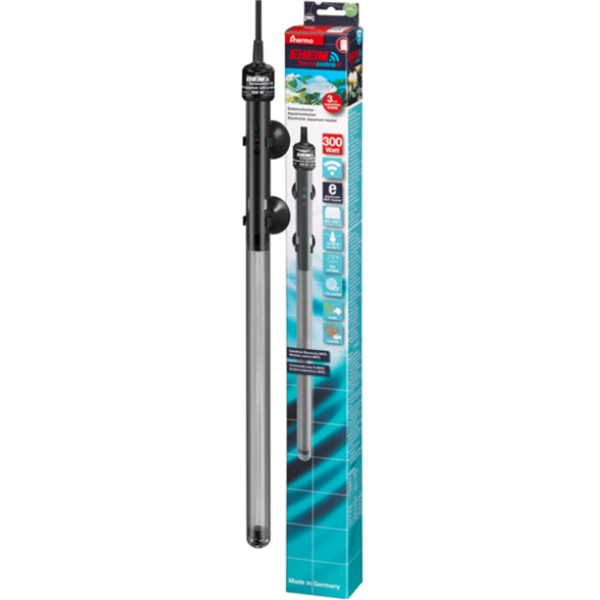
Explore this need in the finder →The EHEIM thermocontrol+ e 300 is the largest North American-capable model in this WLAN family that I reviewed. Its Type 3669 manual row is 300 W, approximately 600–1,000 L (159–264 US gallons), and Ø32 × 486 mm (19.13 in). It is not the classic thermocontrol e300 Type 3639 or the Jäger 300 W Type 3619. Those names and wattage numbers are similar, but their models, control systems, manuals and US retail identifiers are different.
Its 264-gallon maximum is only a screening boundary
The manual lists 264 US gallons as the Type 3669 maximum; the finder accepts 264 and removes it at 265. That boundary is a documented product distinction, not a claim that the heater can overcome all room losses or quickly recover a cold, uncovered tank at the upper limit. Match actual water volume rather than nominal glass capacity, then consider room-to-target difference, insulation, circulation and animal-specific requirements. At 19.13 inches, this is also the longest assessed thermocontrol+ e body: tank depth and mounting position matter. The 250 W Type 3668 stops at 159 gallons and is shorter at 16.97 inches, while no 400 W Type 3670 North American configuration appears in the retrieved manual table.
WLAN control is useful but not active cooling
EHEIM describes adjustment by WLAN from a smartphone, tablet or computer, status lights and optional e-mail notice after a temperature deviation. Its operating manual specifies 2.4 GHz WiFi and walks through connecting a device to the heater network and using a browser to set it up. That is more involved than turning a dial, and should be tested during normal setup rather than treated as a guaranteed remote emergency monitor. An e-mail notification depends on a saved address, and the manufacturer explicitly says the heater does not cool water. It has no way to lower temperature on its own if room or lighting heat raises the aquarium above the selected point.
There is also a published setting-range difference. EHEIM's product page says 18–32°C; the English manual's application section gives 20–32°C ±0.5°C and 68–90°F ±1°F. Because these minimum values are not equivalent, this review uses the manual's explicit Fahrenheit limits for the North American matcher and encourages buyers to inspect the manual supplied with their exact model. A heater setpoint range is not a biological recommendation and does not replace a separate thermometer.
Check the actual unit, marks and placement
The English manual places Type 3669 in the 120–127 V / 60 Hz North American group, while also listing a separate 220–240 V group for Types 3666–3669. A US retailer listing bridges the 300 W WiFi model to UPC 720686011700; that is not a guarantee that a listing photo or physical package matches the desired voltage. The official EHEIM gallery image shows the exact 300 W name but clearly reads 220–240 V, so it remains rejected. This page instead uses a wattage-matched photo tied to the US retailer listing; no voltage label is legible there, so check the package and unit.
Installation remains fully in-tank and vertical. The manual calls for strong flow, a marked minimum water level and no dry operation; the product page describes full submersion but recommends immersion only to a water-level mark for best WiFi reception. The text reviewed does not specify a numerical maximum immersion depth. It is glass, not documented as shatterproof, and the safety cutoff should not be treated as permission to operate without water. Follow the exact supplied diagram and observe cooling instructions before handling.
Bottom line: Type 3669 provides the broadest documented capacity screen in this reviewed family, but it demands a long vertical mounting space and a deliberate WLAN setup. Consider it only after confirming actual volume, model/type, 120–127 V / 60 Hz labeling, waterline instructions and a suitable species-specific target. This assessment is based on manufacturer material, not hands-on testing.
Sources: EHEIM's thermocontrol+ e 300 page, the official Types 3666–3670 manual, and the US retailer category record.
Key specifications
Key details at a glance
| Rated heater power | 300 W |
|---|---|
| Manufacturer aquarium rating | 264 US gal |
| Lowest thermostat setting | 68°F |
| Highest thermostat setting | 90°F |
| Temperature control | Adjustable thermostat |
| Supported water types | freshwater / saltwater |
| Installation route | Fully submerged, in-tank |
| Heater length | 19.13 in |
| Electrical supply | 120 V |
| Line frequency | 60 Hz |
Use the exact model’s instructions for operating limits, supplied equipment and version differences.
Sources for this review
Sources for this assessment
Check the complete aquarium setup
Use the finder to compare documented tank size, water type, installation and temperature-control fit. A match does not guarantee the keeper's species-specific target or measured performance.